

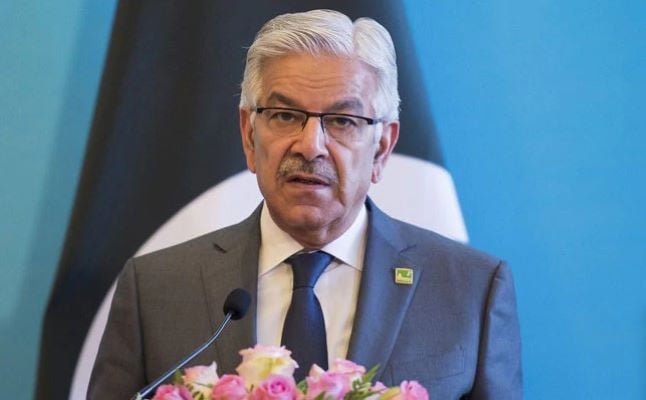

ISLAMABAD: Defense Minister Khawaja Asif on Thursday said that India’s recent unilateral actions—particularly its decision to suspend the Indus Waters Treaty (IWT)—have eroded the sanctity of the 1972 Simla Agreement, which has served as a cornerstone of bilateral relations between the two countries for decades.
“The Simla Agreement was a bilateral accord, with no third-party involvement—not even the World Bank,” Asif said in an interview, adding that in the absence of a binding bilateral framework, the Line of Control (LoC) could effectively revert to being treated as a ceasefire line.
The Simla Agreement, signed in the aftermath of the 1971 war, established key principles to guide Pakistan-India relations, including mutual respect for the LoC and commitment to peaceful resolution of disputes. However, Asif argued that India’s recent actions—including its abrupt termination of the IWT and military provocations—have rendered the agreement “irrelevant.”
His comments come following last month’s deadly attack in Indian Illegally Occupied Jammu and Kashmir (IIOJK), which killed 26 tourists. Without providing evidence, India blamed Pakistan for the incident, leading to cross-border military escalation.
In response, Pakistan launched Operation Bunyan-um-Marsoos, a large-scale military operation targeting Indian military installations. Pakistan’s armed forces reportedly downed six Indian fighter jets, including three Rafale aircraft, and intercepted numerous drones. After nearly four days of hostilities, a ceasefire agreement was reached on May 10, brokered by the United States.
Asif reiterated Pakistan’s longstanding position that treaties and agreements between the two countries would become meaningless if India continues to act unilaterally. Commenting on the IWT, he said, “India cannot unilaterally walk away from the treaty or obstruct the flow of water. It’s a multilateral agreement with established legal parameters.”
Diplomatic Push Following Ceasefire
In the aftermath of the military confrontation, Islamabad launched a diplomatic offensive to present its version of events on the global stage. Prime Minister Shehbaz Sharif appointed former foreign minister and PPP Chairman Bilawal Bhutto Zardari to lead a high-level delegation aimed at countering Indian propaganda and reaffirming Pakistan’s commitment to peace.
The delegation includes senior political and diplomatic figures: Dr Musadik Malik, Khurram Dastgir Khan, Senator Sherry Rehman, Hina Rabbani Khar, Senator Faisal Sabzwari, former foreign secretary Tehmina Janjua, and former ambassador Jalil Abbas Jilani.
The group is engaging international stakeholders, including the United Nations, to highlight the risks posed by India’s actions and the importance of sustained international mediation to ensure peace in South Asia.
