

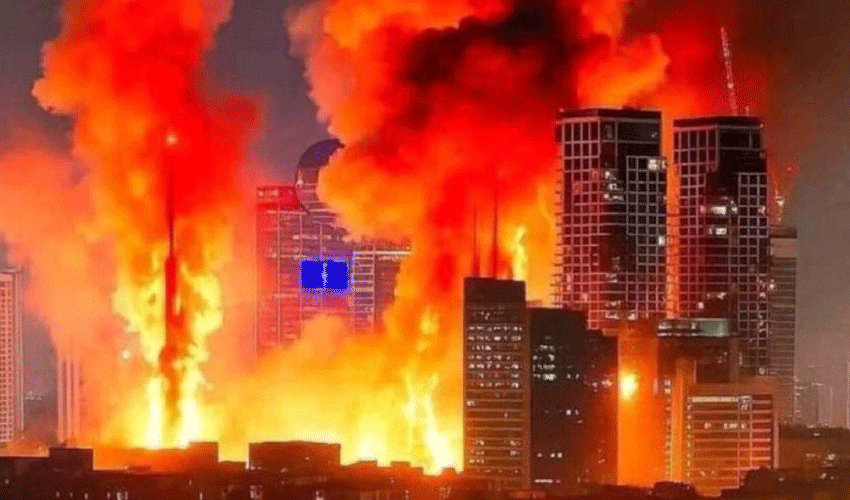

Iran launched its fifth wave of missile strikes against Israel on Saturday, intensifying its ongoing retaliation in what Tehran calls the “True Promise 3” campaign. The latest salvo included ballistic and hypersonic missiles targeting key Israeli cities, resulting in at least four fatalities and more than 90 injuries, further heightening fears of a broader regional conflict.
According to both Iranian and international sources, the strikes hit multiple locations across Israel, including Tel Aviv and Haifa, where eyewitnesses reported powerful explosions. Air raid sirens blared throughout northern Israel, urging residents to take immediate shelter.
Iranian state media, citing Israeli sources, claimed that a 50-storey building in Tel Aviv suffered significant structural damage. Despite the activation of Israel’s air defence systems—including the Iron Dome and David’s Sling—many missiles reportedly bypassed these defences and hit critical infrastructure.
The missile barrage began late Thursday and continued into Friday, causing widespread panic and damage. Emergency services confirmed four deaths, including a woman, while over 90 people were injured. In Tel Aviv alone, at least seven individuals sustained minor injuries. Authorities have reportedly imposed a ban on filming or sharing footage of the destruction caused by the strikes.
In a parallel claim, Iran’s Tasnim News Agency reported that its air defence units shot down two Israeli warplanes and captured a female pilot. However, this information remains unverified, as Israeli authorities have yet to comment.
This marks the fifth phase of Iran’s retaliatory response following Israel’s June 13 pre-dawn airstrike on Iranian territory. That attack targeted military and nuclear sites and resulted in the deaths of several senior Iranian officials, including Major General Mohammad Baqeri, Chief of Staff of the Iranian Armed Forces, and Major General Hossein Salami, head of the Islamic Revolutionary Guard Corps (IRGC), as well as six nuclear scientists. Iranian reports stated that at least 78 civilians, among them women and children, also perished.
Describing the Israeli strike as one of the most extensive in recent memory, Iran’s leadership responded forcefully. Supreme Leader Ayatollah Ali Khamenei stated that Israel had “sealed its bitter and painful fate” by attacking Iranian soil.
Reports from global media outlets confirm that hundreds of missiles have now been exchanged between the two nations within just a few days, sparking global alarm. Analysts warn that if unchecked, the situation could escalate into a full-scale Middle Eastern war.
Israeli police confirmed that while several missiles were intercepted, those that landed caused heavy property damage in residential areas of Tel Aviv and Haifa. “So far, four fatalities and over 90 injuries have been confirmed. The damage to infrastructure and property is substantial,” said a police spokesperson.
Iran maintains that its actions are defensive in nature, aimed at holding Israel accountable for breaching its sovereignty and targeting high-profile figures. Iranian authorities insist that their missile attacks have been confined to military and critical infrastructure targets within Israeli territory.
As tensions continue to mount, emergency meetings have been convened by the Israeli cabinet, and public events across major cities have been cancelled. In Iran, state television broadcast footage showing heightened military readiness and deployment of defence units across key regions.
At the time of reporting, neither the United States nor the United Nations had issued an official response. Diplomatic analysts caution that immediate international mediation is essential to prevent a full-blown conflict from engulfing the wider region.
