

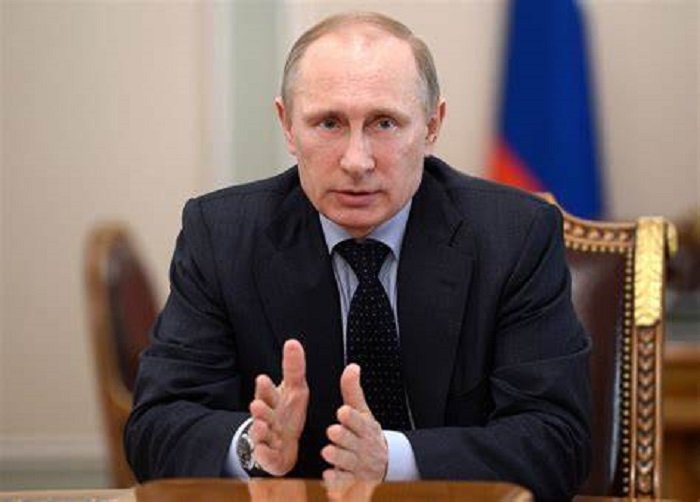

ST PETERSBURG: Russian President Vladimir Putin declined to comment on claims suggesting that Israel and the United States may be plotting to assassinate Iran’s Supreme Leader, Ayatollah Ali Khamenei, firmly stating: “I do not even want to discuss this possibility.”
Speaking to senior editors of major news agencies in St Petersburg, Putin emphasized that the Iranian people continue to support their leadership in Tehran, despite internal political complexities.
His remarks came amid heightened tensions, as Israeli Prime Minister Benjamin Netanyahu has openly suggested that Israel’s military campaign could lead to regime change in Iran. Meanwhile, U.S. President Donald Trump recently stated that Washington knows Khamenei’s whereabouts but has “no plans to kill him—for now.”
When asked directly how he would respond if Israel, with U.S. support, were to assassinate Khamenei, Putin reiterated his refusal to engage with the premise. “I’ve heard those remarks,” he said, “but I will not comment further. I simply don’t want to.”
Putin called for de-escalation and urged all sides to seek a peaceful resolution—one that respects both Iran’s right to pursue civil nuclear energy and Israel’s right to security.
“As we observe the internal political dynamics in Iran, we also see a consolidation of public support around the country’s political leadership,” he noted.
The Russian leader’s comments come as uncertainty grows over potential U.S. involvement in Israeli strikes targeting Iran’s nuclear and missile infrastructure. For a sixth consecutive day, Iranian civilians have reportedly been fleeing the capital amid ongoing air raids.
Putin confirmed he had been in contact with both Trump and Netanyahu, and that Russia had presented its proposals to help resolve the conflict. He also emphasized that Iran’s key nuclear facilities remain operational. “These underground enrichment facilities still exist—they haven’t been touched,” he said.
Addressing the possibility of regime change, Putin cautioned that any such strategy should be carefully evaluated for its actual outcomes. “Before setting that as a goal, one must ask: is it even achievable?”
When questioned about whether Russia would supply Iran with advanced weapons to defend itself against Israeli attacks, Putin clarified that the strategic cooperation agreement signed with Iran in January does not include military support. He added that no formal request for such assistance had been made by Tehran.
Meanwhile, Russian Deputy Foreign Minister Sergei Ryabkov issued a strong warning on Wednesday, urging the United States not to launch strikes on Iran. He said such action could “radically destabilize” the Middle East. A Russian Foreign Ministry spokesperson also cautioned that Israeli attacks on Iranian nuclear facilities could risk triggering a nuclear disaster.
Putin noted that Israel had assured Russia its airstrikes would not endanger Russian engineers working on two additional reactors at Iran’s Bushehr nuclear power plant.
“We maintain a very strong relationship with Iran,” Putin said. “Russia is in a position to safeguard Iran’s interests in the area of peaceful nuclear energy.”
Moscow has proposed a framework in which it would supply nuclear fuel to Iran and take back spent uranium, ensuring the program remains peaceful while addressing Israeli concerns.
“It is entirely possible to protect Iran’s civil nuclear interests and at the same time alleviate Israel’s legitimate security fears,” Putin concluded. “We’ve presented our ideas to our partners in the U.S., Israel, and Iran.”
