

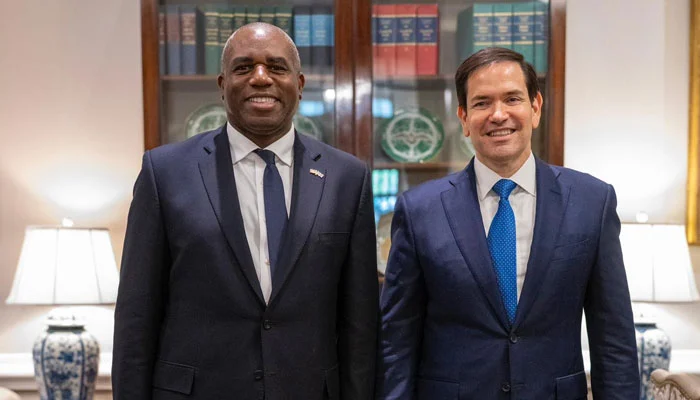

British Foreign Secretary David Lammy has expressed hope that a peaceful agreement on Iran’s nuclear programme can still be reached, saying a two-week window remains open to pursue diplomacy and prevent further escalation in the Middle East.
Speaking ahead of critical negotiations in Geneva, Lammy emphasized the urgency of swift action to avoid a broader regional conflict. “We discussed how Iran must commit to a deal to prevent deeper hostilities,” he said, following his meeting with U.S. Secretary of State Marco Rubio and special envoy Steve Witkoff in Washington.
Lammy is scheduled to meet with Iranian Foreign Minister Abbas Araghchi on Friday in Geneva, alongside his French, German, and EU counterparts. The talks are part of a broader European effort to ease tensions sparked by Israel’s continued airstrikes on Iran’s nuclear infrastructure and Tehran’s retaliatory missile attacks.
“The situation in the Middle East remains dangerous,” Lammy warned in a statement released by the British embassy. “A diplomatic window still exists — but it is rapidly narrowing.”
The United Kingdom, France, Germany, and the European Union are all working together to revive negotiations. These nations were original signatories of the 2015 Iran nuclear deal, which aimed to curb Tehran’s nuclear ambitions in exchange for sanctions relief. However, the agreement was abandoned by then-President Trump during his first term.
Despite renewed tensions, European leaders continue to advocate diplomacy as the only viable path forward. French President Emmanuel Macron recently directed his foreign minister to coordinate with allies on a proposal to resolve the Israel-Iran conflict through talks.
Iran’s Foreign Minister Araghchi confirmed his attendance in Geneva and reiterated Iran’s openness to dialogue. The upcoming negotiations will also include French Foreign Minister Jean-Noël Barrot, German Foreign Minister Johann Wadephul, and EU foreign policy chief Kaja Kallas.
Both Lammy and Rubio agreed that Iran must never be allowed to develop or acquire nuclear weapons. Lammy reaffirmed this point, adding that “now is the time to stop the violence and prevent a regional disaster that benefits no one.”
France’s Foreign Minister Barrot emphasized that his country remains committed to negotiating limits on Iran’s nuclear and ballistic missile programmes. He has been in frequent contact with his British and German counterparts since Israel launched its air campaign last Friday.
While Iran continues to enrich uranium to 60% — significantly higher than the 3.67% cap set by the 2015 accord but still below the weapons-grade threshold of 90% — Tehran insists its nuclear activities are peaceful and denies any intention of building nuclear weapons.
Meanwhile, U.S. President Donald Trump is still considering military action against Iran’s nuclear facilities as the conflict between Israel and Iran intensifies.
