

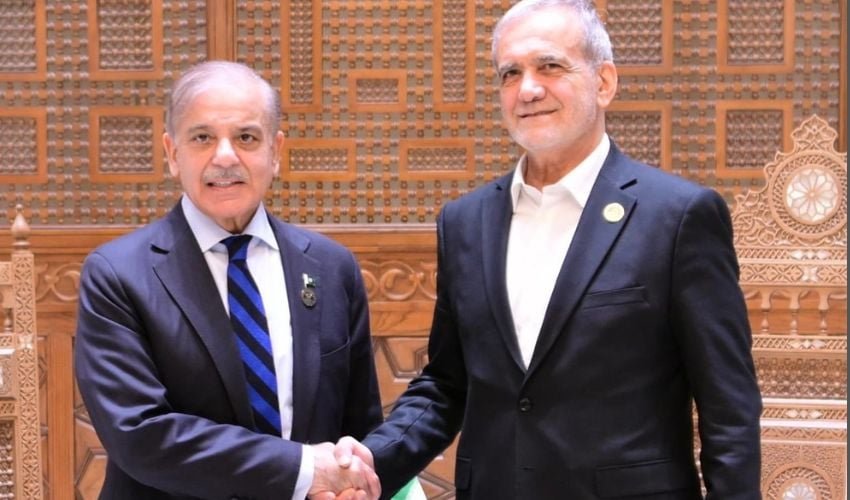

Prime Minister Shehbaz Sharif held a phone call with Iranian President Masoud Pezeshkian on Tuesday, during which the two leaders discussed the escalating crisis in the Middle East. Both leaders underlined the importance of resolving the conflict through diplomatic channels rather than military escalation.
According to the Prime Minister’s Office, PM Shehbaz conveyed Pakistan’s grave concern over the deteriorating regional security situation. He emphasized the urgent need to de-escalate tensions and restore stability through dialogue, in line with international law and the principles enshrined in the United Nations Charter.
The premier reaffirmed Pakistan’s unwavering support for Iran on key international forums such as the United Nations Security Council (UNSC) and the Organisation of Islamic Cooperation (OIC), pledging continued solidarity amid growing regional instability.
In response, President Pezeshkian expressed gratitude for Pakistan’s consistent and principled stance, describing Islamabad’s role as both constructive and stabilizing. He acknowledged Pakistan’s efforts to promote peaceful resolution and discourage further escalation.
The two leaders also agreed on the critical need for unity within the Muslim world in addressing evolving geopolitical challenges. They pledged to stay in close contact and maintain coordination to promote regional peace and collective strength.
Separately, Deputy Prime Minister and Foreign Minister Ishaq Dar welcomed the recently announced ceasefire between Iran and Israel. In a statement on X (formerly Twitter), Dar expressed optimism that the truce could open the door to long-term peace and regional stability.
“I am immensely delighted and Pakistan warmly welcomes today’s ceasefire between Iran and Israel,” Dar stated. “We commend all those who played a pivotal role in facilitating this breakthrough and hope that this positive development will contribute to lasting peace in the Middle East.”
Dar reiterated Pakistan’s commitment to peaceful conflict resolution and stressed that all international disputes should be addressed in accordance with the UN Charter, particularly the respect for national sovereignty and territorial integrity.
The ceasefire, brokered by the United States, was announced by President Donald Trump, who declared a “complete and total” halt to hostilities between Israel and Iran. However, the truce’s status remains uncertain, with Israel accusing Iran of violating the agreement by launching missile attacks. Tehran has denied these claims, asserting that its military action had ceased following the agreement.
Trump, en route to the NATO summit in The Hague, warned Israel not to drop any more bombs, declaring on social media that “THE CEASEFIRE IS NOW IN EFFECT. PLEASE DO NOT VIOLATE IT!” He later told reporters he was particularly upset with Israel for allegedly continuing strikes immediately after the truce was announced.
Israel’s Prime Minister’s Office later issued a statement confirming that further attacks on Iran had been called off following a phone conversation between Netanyahu and Trump. Meanwhile, Iran’s Supreme National Security Council stated that the “powerful military response” delivered earlier had compelled Israel to halt its aggression.
The truce comes after 12 days of intense warfare between the two regional rivals. During this time, Israel reportedly carried out targeted airstrikes on Iranian nuclear facilities, prompting retaliatory actions from Tehran.
According to Human Rights Activists, a Washington-based group, at least 974 people have been killed in Iran as a result of Israeli airstrikes, while 3,458 others have been wounded. In Israel, the conflict has left at least 24 dead and over 1,000 injured.
The ceasefire announcement has been welcomed by several international actors, including Russia, France, Germany, and Saudi Arabia, who view the development as a much-needed pause in an increasingly volatile regional landscape.
