

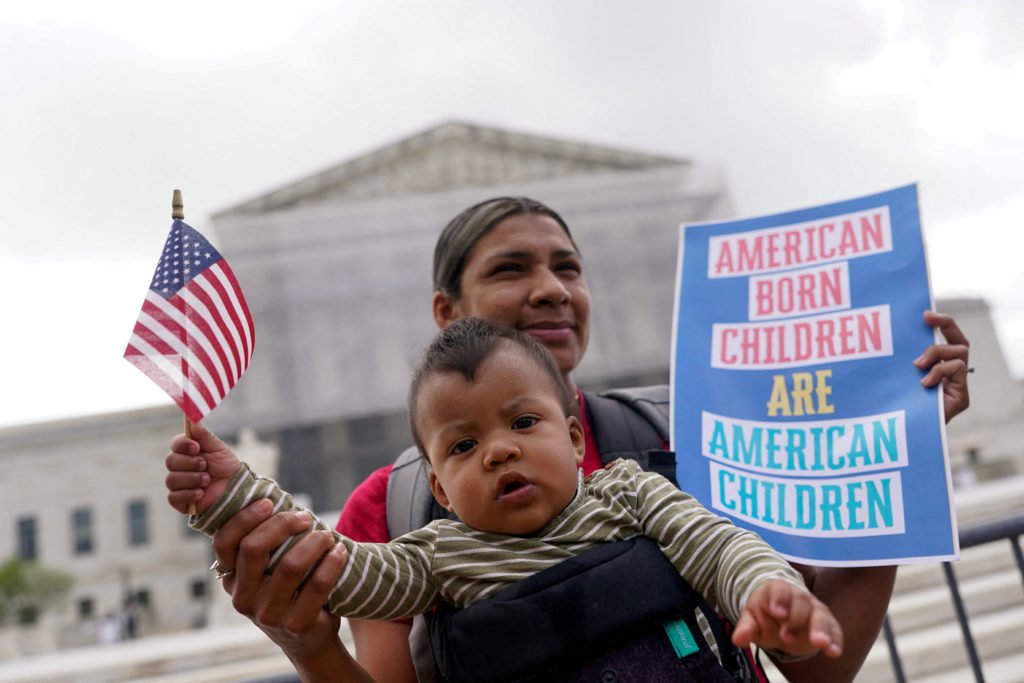

WASHINGTON, D.C.: The future of birthright citizenship in the United States has entered uncertain legal territory following a major U.S. Supreme Court ruling that, while not addressing the constitutionality of the policy, delivered a procedural win to former President Donald Trump’s effort to restrict it.
The Court ruled on Friday to limit the power of federal district judges to issue nationwide injunctions, a move that weakens the legal tools immigrant rights groups have used to block Trump’s executive order denying citizenship to children born in the U.S. to undocumented or temporary immigrants.
The ruling sends the legal challenges to Trump’s order back to lower courts for further proceedings, leaving the controversial directive blocked for now but no longer under broad national protection.
A Core Constitutional Right Under Threat?
Birthright citizenship, grounded in the 14th Amendment of the U.S. Constitution, has been a cornerstone of American law since 1868. It guarantees citizenship to “all persons born or naturalized in the United States,” regardless of their parents’ immigration status.
The precedent was reinforced in the landmark 1898 Wong Kim Ark decision, in which the Supreme Court ruled that a U.S.-born man of Chinese immigrant parents was indeed a citizen. Legal experts have long viewed the doctrine as settled constitutional law.
Trump’s January executive order challenges that interpretation, targeting children born to non-citizens who are in the U.S. unlawfully or on temporary visas. Trump and his allies argue that such children are not “subject to the jurisdiction” of the United States and therefore not entitled to automatic citizenship — a claim widely rejected by legal scholars and lower courts.
Legal Battle Far From Over
Federal judges in multiple states had blocked the executive order, calling it unconstitutional. “This is a blatantly unconstitutional order,” said U.S. District Judge John Coughenour in a Seattle court earlier this year. Another federal judge, Deborah Boardman of Maryland, noted that “no court in the country has ever endorsed” the administration’s interpretation of the 14th Amendment.
However, the Supreme Court did not evaluate the legality of the policy itself. Instead, the justices sided with the administration on a procedural issue, ruling that lower courts exceeded their authority by issuing nationwide injunctions.
Legal analysts say the administration’s strategy — focusing on the scope of judicial relief rather than the substance of the policy — proved successful.
“The Trump administration made a strategic decision, which clearly paid off,” said Jessica Levinson, a professor at Loyola Law School. “They challenged the process, not the merits.”
What’s Next?
The Supreme Court’s decision gives the lower courts 30 days to reassess their rulings based on the new legal framework. In the meantime, the executive order remains blocked.
Opponents are now shifting their strategy to class-action lawsuits. Two such suits were filed Friday in Maryland and New Hampshire, aiming to secure broader relief. But legal experts caution that securing nationwide protections through class actions is a steep challenge.
“It’s not a simple workaround,” said Suzette Malveaux, professor at Washington and Lee University. “Courts have made nationwide class certification increasingly difficult.”
Warning of Chaos and Inequality
Immigration and civil rights groups warn that if Trump’s order is enforced in some states but blocked in others, the result could be a patchwork of conflicting laws and widespread uncertainty for families.
“By denying uniform enforcement of birthright citizenship, the Court has invited chaos, inequality, and fear,” said Krish O’Mara Vignarajah, president of Global Refuge, a nonprofit that supports migrants and refugees.
In a dissenting opinion, Justice Sonia Sotomayor urged lower courts to act quickly, warning of the danger of policies as “blatantly unlawful and harmful” as the Citizenship Order.
While the ruling marks a key procedural victory for the Trump camp, the broader constitutional question — whether birthright citizenship can be restricted by executive order — remains unsettled. With more litigation expected, the fate of one of the nation’s foundational legal principles now rests with the lower courts and, potentially, a future ruling by the Supreme Court itself.
