

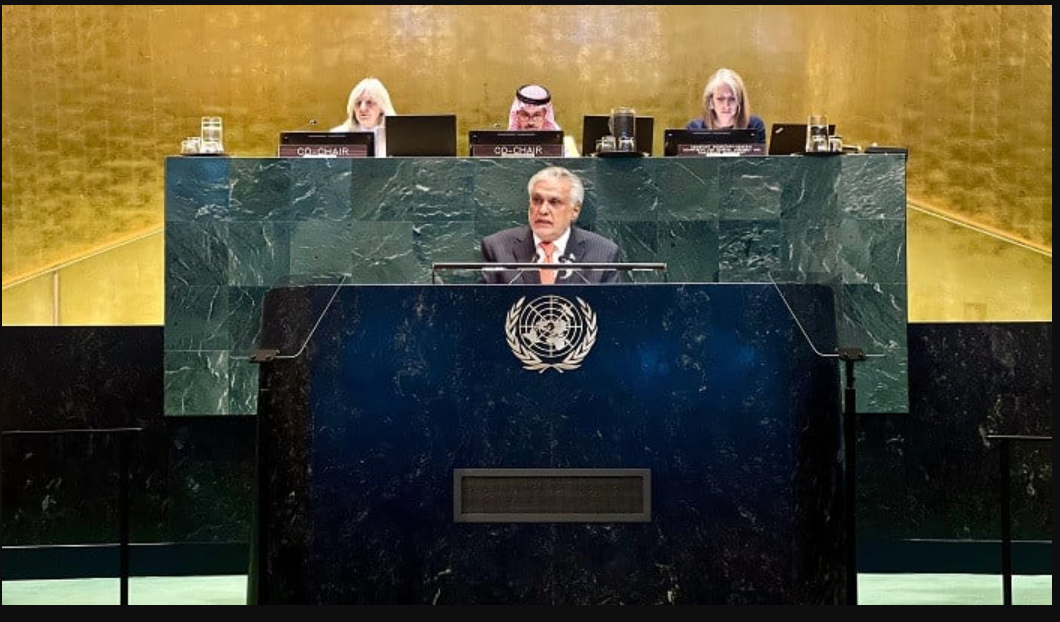

Deputy Prime Minister and Foreign Minister Ishaq Dar has called for full United Nations membership for Palestine, stressing the urgent need for a permanent ceasefire in Gaza and the immediate delivery of humanitarian aid. Speaking at the “International Conference on the Peaceful Settlement of the Question of Palestine and the Implementation of the Two-State Solution” held at the United Nations, Dar condemned ongoing Israeli actions in Gaza and called for a unified global response.
“The blockade of aid and the systematic targeting of civilian infrastructure, including refugee camps, hospitals, and humanitarian convoys, have violated every principle of international law and human decency,” he said. “This collective punishment must stop now.”
Co-hosted by Saudi Arabia and France, the conference aimed to advance momentum toward a two-state solution. The deputy prime minister praised recent decisions by European countries to recognize Palestinian statehood, particularly highlighting France’s leadership. He urged other nations to follow suit and lend their support to the growing international consensus.
Dar emphasized that Gaza has become symbolic of the erosion of humanitarian norms. “With over 58,000 Palestinians, mostly women and children killed, the scale of destruction constitutes a grave breach of international humanitarian law, UN resolutions, and measures outlined by the International Court of Justice,” he noted.
Expressing Pakistan’s firm commitment to a peaceful and just resolution, Dar announced the country’s readiness to provide direct support to Palestine beyond diplomacy. “Pakistan is prepared to offer technical assistance and capacity-building support in areas such as public administration, health, education, and service delivery in full coordination with Palestinian authorities.”
He also reiterated Pakistan’s willingness to contribute to international protection mechanisms and to participate in the Arab-OIC Plan for rebuilding institutions in Palestine.
Dar concluded with a strong call to action, warning that prolonged injustice only invites further instability. “The occupation must end. It is time to give the Palestinian people hope through freedom, self-determination, and statehood. Full UN membership for Palestine is the clearest path toward lasting peace in the region.”
UN Secretary-General António Guterres echoed these sentiments during his opening address. He described the destruction in Gaza as “unbearable” and emphasized that the time for action is now. Guterres called the conference a critical opportunity to move forward with a viable two-state solution and to end the occupation.
French Foreign Minister Jean-Noël Barrot underscored that the war in Gaza must end, but he stressed that a sustainable resolution must follow. “This cannot be the endpoint. The region’s peace and stability depend on a lasting solution,” he said, reiterating that there is no alternative to a negotiated two-state outcome.
However, notable absences at the conference were the United States and Israel. The US State Department criticized the timing of the event, arguing that it could hinder rather than help the peace process.
Despite their absence, the conference marked a growing international push toward securing Palestinian statehood and establishing a clear political path to peace.
