

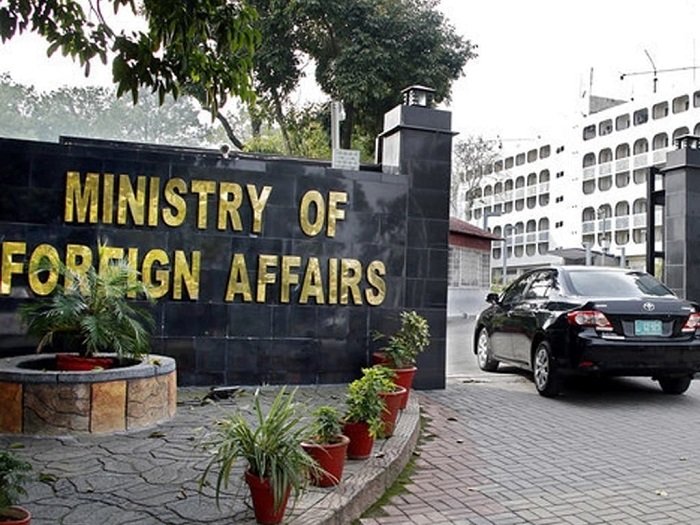

FO Spokesperson: India Failed Strategically, Seeks to Justify Aggression
ISLAMABAD: Pakistan has categorically dismissed India’s claims surrounding “Operation Mahadev,” labeling them as fabricated and strategically irrelevant. During his weekly press briefing, Foreign Office spokesperson Shafqat Ali Khan strongly criticised Indian Home Minister Amit Shah’s recent parliamentary remarks, asserting that they were rooted in “lies and fictional storytelling.”
The Indian government, earlier this week, claimed that three men killed in Indian Occupied Jammu and Kashmir (IIOJK) were Pakistani nationals involved in the Pahalgam attack, citing the recovery of Pakistani voter ID cards and local chocolates as evidence. Shah’s comments were framed as part of India’s so-called Operation Mahadev — a counter-terrorism campaign that New Delhi claims exposed cross-border involvement.
However, Pakistan firmly rejected these assertions. Khan stressed that the Indian narrative lacks credibility and holds no strategic or diplomatic significance for Islamabad. He denounced what he called India’s “nuclear blackmailing rhetoric” and attempts to justify unprovoked aggression through distortion of facts.
Pakistan Accuses India of Fabrication and Aggressive Posturing
The Foreign Office also condemned India’s military actions on the night of May 6 and 7, which Khan said were carried out without investigation or credible evidence related to the Pahalgam incident. According to the spokesperson, those attacks resulted in civilian casualties and failed to achieve any strategic objectives for India.
Khan highlighted that Pakistan responded “decisively and proportionately” by targeting Indian aircraft and assets, demonstrating its military readiness and commitment to defending its sovereignty. He pointed out that Pakistan had called for an independent and transparent investigation into the Pahalgam incident, but India refused and chose instead to escalate tensions.
“India became judge, jury, and executioner,” Khan remarked, accusing New Delhi of fabricating evidence and acting unilaterally. He urged Indian leaders to acknowledge their setbacks and accept the necessity of third-party mediation in such volatile matters.
Khan also criticised India’s approach to the Indus Waters Treaty, calling its suspension a violation of international agreements. He labeled India’s unilateral moves as dangerous and counterproductive, undermining regional peace and stability.
Rejecting India’s assertion of a “new normal” in the region, Khan emphasized that only mutual respect, adherence to the UN Charter, and diplomatic dialogue can serve as the foundation for peaceful bilateral relations. He accused Indian leadership of inciting war hysteria, spreading misinformation, and destabilizing the region through irresponsible rhetoric.
In conclusion, Khan reiterated that while India continues to fan the flames of hostility, Pakistan remains committed to regional peace, stability, and meaningful engagement based on facts, law, and mutual respect.
