

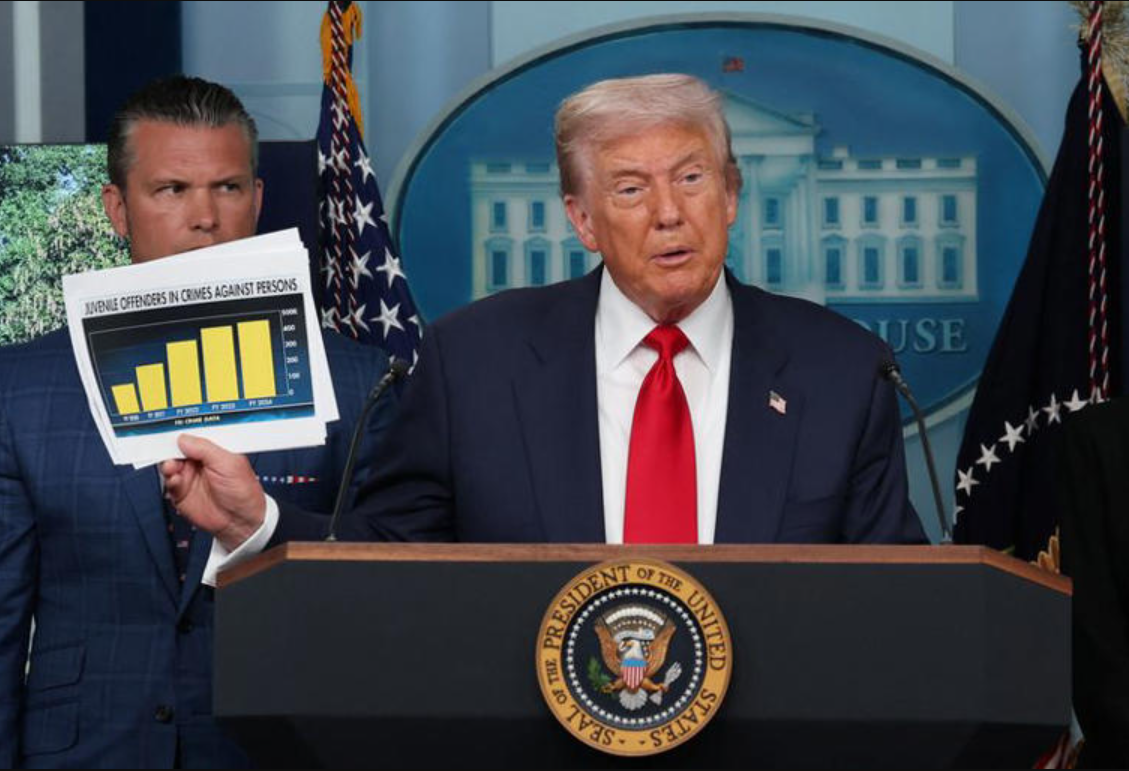

US President Donald Trump announced on Monday that he is deploying 800 National Guard troops to Washington, DC, and placing the city’s Metropolitan Police Department under direct federal control. He claimed the move was necessary to address what he described as a “wave of lawlessness” in the US capital, a statement at odds with official statistics showing violent crime at a 30-year low in 2024.
Speaking at the White House alongside senior officials, including Defense Secretary Pete Hegseth and Attorney General Pam Bondi, Trump declared a “public safety emergency” in Washington. He asserted that the city had been “overtaken by violent gangs and bloodthirsty criminals,” pledging that the federal government would act decisively.
This announcement follows the president’s broader pattern of targeting Democrat-led cities and increasing federal involvement in matters traditionally handled at the local level. Trump dismissed accusations that he is inflating the threat to justify expanding presidential authority in a city where residents overwhelmingly vote for Democratic candidates.
In recent days, hundreds of officers and agents from multiple federal agencies, including the FBI, DEA, ATF, and ICE, have been deployed throughout the city. Trump said the US military could also be sent in “if needed.” Hegseth indicated readiness to bring in additional National Guard units from outside the city, while Bondi was tasked with overseeing the police department’s transition to federal control.
Washington Mayor Muriel Bowser strongly rejected Trump’s depiction of the city, stating that violent crime fell 35% in 2024 and has dropped another 26% in the first seven months of 2025. Overall crime has also decreased by 7%, according to the Metropolitan Police Department.
Trump has suggested that his administration is reviewing legal avenues to overturn Washington’s Home Rule Act of 1973, which grants the city a measure of self-governance under congressional oversight. Such a move would likely require an act of Congress. The president invoked a section of the act that allows temporary federal control of the police force in “special emergency conditions.”
Critics have pointed out the contradiction between Trump’s claims of a crime crisis and his administration’s decision to cut $20 million from the National Capital Region’s federal urban security fund this yea, a 44% reduction from 2024.
The deployment of National Guard forces follows Trump’s similar action in Los Angeles earlier this year, where 5,000 troops were sent in response to protests over immigration enforcement. That move was met with resistance from state and local leaders, who called it inflammatory and unnecessary.
Trump’s authority over the DC National Guard is broader than in states, where governors control troop activation. Federal forces have been sent to Washington before, most notably in response to the January 6, 2021, Capitol attack. During his first term, Trump deployed the National Guard to suppress largely peaceful protests over police brutality in 2020, a decision criticized by civil rights groups and opposed by Bowser.
The US military is generally prohibited from direct domestic law enforcement activities under federal law. Still, Trump has frequently used the issue of crime, particularly in urban areas, as a political focal point since the 1980s. His controversial involvement in the 1989 Central Park jogger case, where he called for the death penalty for five Black and Latino teenagers later proven innocent, remains a defining moment in his public life. Those individuals have since sued Trump for defamation after he falsely claimed during a presidential debate last year that they had pleaded guilty.
