

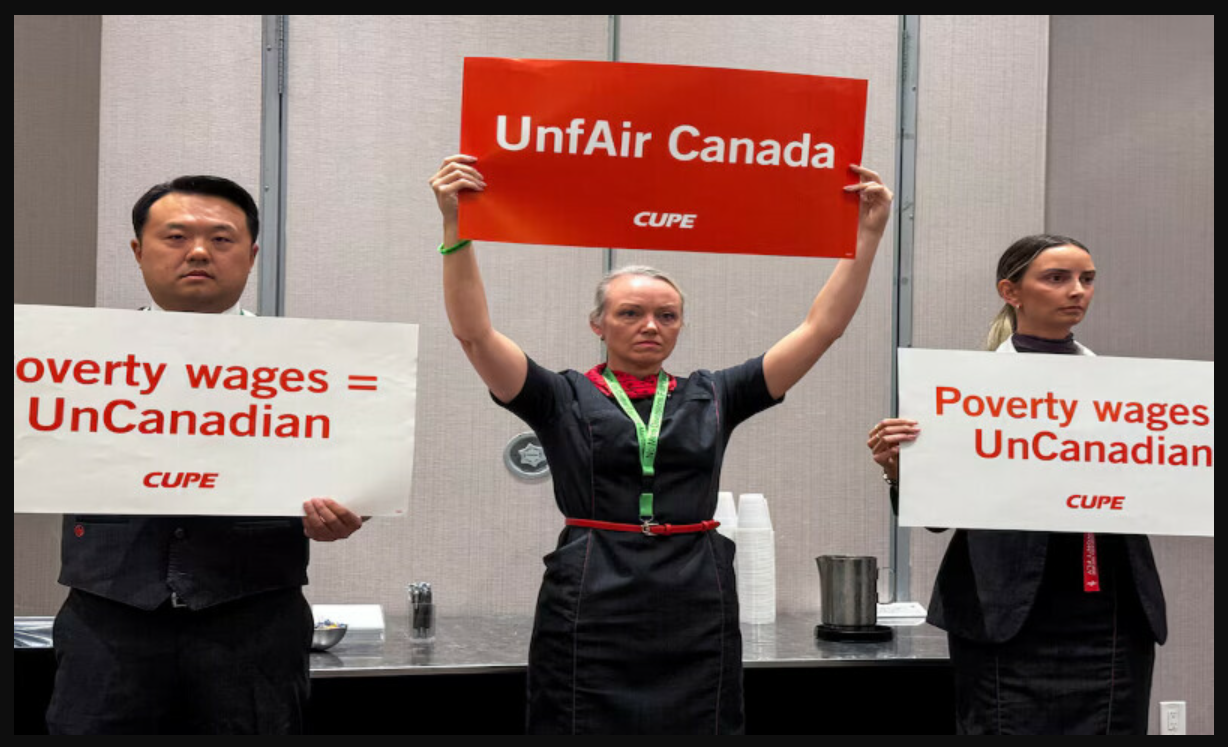

The threat of a nationwide strike by Air Canada’s unionized flight attendants has placed the country’s largest airline in a tense standoff, raising concerns for passengers, the tourism industry, and the broader economy. With thousands of travelers already affected, the dispute centers on wages and long-standing frustrations over unpaid work hours.
Hundreds of Flights Canceled Ahead of Deadline
Air Canada confirmed that it began winding down operations on Friday as the strike deadline approached. By late evening, 623 flights had already been canceled, disrupting travel plans for more than 100,000 passengers across domestic and international routes. The looming work stoppage was scheduled to begin just after midnight on Saturday, threatening to paralyze operations at major airports including Toronto Pearson, Montreal-Trudeau, and Vancouver International.
The cancellations marked one of the busiest travel weekends of the year, sparking frustration among passengers. Many travelers expressed both inconvenience and support for flight attendants, noting that their demands reflect long-standing grievances in the airline industry.
Union Pushes for Higher Wages and Fair Pay for All Hours Worked
At the heart of the dispute is the issue of compensation. Flight attendants in Canada, like many of their counterparts worldwide, are only paid when the aircraft is in motion. Hours spent boarding passengers, assisting with safety checks, and managing delays often go unpaid.
The Canadian Union of Public Employees (CUPE), which represents more than 10,000 flight attendants at Air Canada, has demanded salary increases and compensation reforms to address this gap. The union argues that flight attendants are critical to passenger safety and comfort, yet their contributions are undervalued by outdated pay structures.
Recent agreements at American Airlines and Alaska Airlines in the United States have granted attendants pay during boarding and, in some cases, compensation between flights. Air Canada’s workers want similar recognition.
Government Pressure and Possible Arbitration
Canada’s Minister of Jobs and Families, Patty Hajdu, urged both sides to stay at the bargaining table and find common ground. Under the Canada Labour Code, the government has the authority to request binding arbitration through the Industrial Relations Board if the dispute threatens the economy.
While the board operates independently, it typically agrees to arbitration requests after reviewing the case. This process could delay or even prevent a strike, but unions have warned that such intervention undermines collective bargaining rights.
The union insists that the possibility of government-imposed arbitration has already weakened the airline’s willingness to negotiate seriously. CUPE has maintained that its preference is to reach an agreement voluntarily rather than through legal intervention.
Impact on Travelers and the Economy
Toronto Pearson International Airport was the hardest hit by cancellations, with long lines of confused passengers seeking updates on flight statuses. For families traveling during the summer holiday season, the disruption added stress to already busy travel schedules.
Despite the inconvenience, some passengers voiced support for flight attendants, emphasizing that the issue is rooted in fairness. One traveler stated that flight crews deserve better pay for the hours they dedicate to passenger safety and service.
Industry analysts warn that a strike could cost Air Canada as much as C$300 million (US$217 million) in lost revenue if it lasts three days. The Toronto Region Board of Trade has urged Ottawa to act quickly, warning that disruptions could damage Canada’s international reputation as a reliable travel hub.
Broader Labour Tensions in Aviation
The dispute at Air Canada is part of a larger wave of labor activism in the aviation sector. Flight attendants in the United States, including those at United Airlines, have also pushed back against contracts that fail to account for unpaid hours. With global airlines facing staffing shortages and rising demand for travel, unions are seizing the moment to demand structural reforms.
Air Canada, which carries approximately 130,000 passengers daily through its mainline and low-cost Rouge affiliate, remains a vital connector between Canada and the United States. Any prolonged strike could strain not only domestic travel but also international routes, particularly cross-border services that remain in high demand despite recent trade frictions.
As the clock ticks down, the possibility of the first Air Canada flight attendants’ strike since 1985 hangs in the balance. The outcome will depend on whether both sides can make meaningful progress at the negotiating table, or whether government intervention forces a resolution.
For travelers, the uncertainty underscores the fragile balance between corporate operations, employee rights, and passenger expectations. For flight attendants, it is a defining moment to secure recognition for the work they perform both inside and outside the cabin.
