

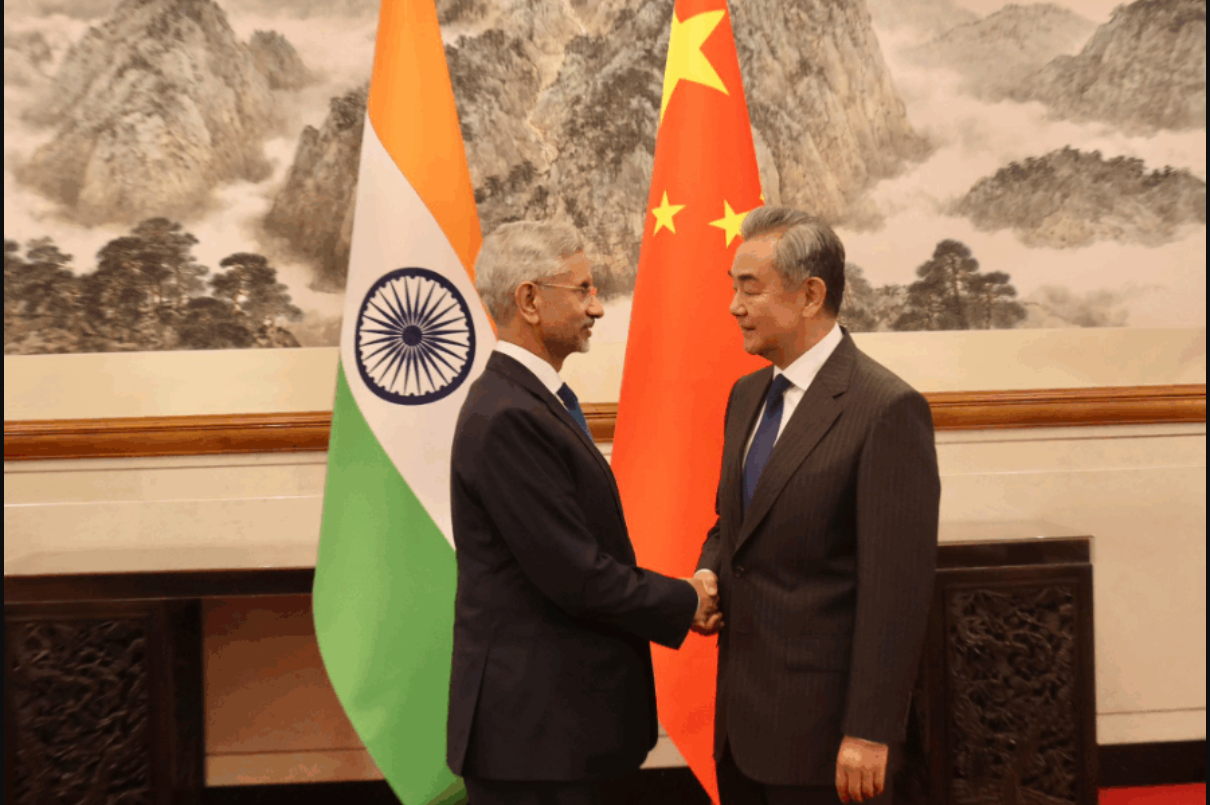

China has urged India to adopt a cooperative approach in their bilateral relationship, emphasizing partnership and mutual benefit instead of rivalry. Chinese Foreign Minister Wang Yi made the remarks during his meeting with Indian Foreign Minister Subrahmanyam Jaishankar in New Delhi. The visit marked an important step in restoring dialogue and rebuilding confidence between the two Asian powers, whose ties had been strained since a deadly border clash in 2020.
Wang Yi stated that China was prepared to uphold principles of cordiality, equality, and mutual benefit with India, urging both sides to establish what he described as a “correct strategic understanding.” According to him, the two nations should view each other as partners and opportunities rather than threats or competitors.
Restoring Dialogue and Cooperation
Both foreign ministers highlighted the need for continued engagement across multiple fronts. Discussions focused on border peace, trade, connectivity, cultural exchanges, and cooperation in areas such as river data sharing and pilgrimages.
Jaishankar described the talks as productive, noting that they would contribute to building a stable, cooperative, and forward-looking partnership between India and China. He also emphasized that peace along the disputed border remained the foundation for any meaningful progress in bilateral ties.
Wang Yi pointed out that exchanges and dialogue at different levels between both countries had been gradually restored in recent months. He expressed optimism that bilateral relations were shifting back toward cooperation and mutual development.
Border Issues Remain Central
The two sides agreed that resolving tensions along the disputed Himalayan border was critical to fostering broader cooperation. Jaishankar stressed that “the basis for any positive momentum in India-China ties is the ability to jointly maintain peace in border areas.”
He added that both nations needed to adopt a candid and constructive approach to move beyond recent difficulties. A key priority remains the pullback of troops amassed on both sides of the western Himalayan border, where tensions have persisted since the violent clash of June 2020 that claimed the lives of 20 Indian soldiers and four Chinese troops.
Wang’s visit also included preparations for the 24th round of border talks with Indian National Security Adviser Ajit Doval. These discussions aim to build on earlier agreements reached between leaders in 2024, which helped reduce military tensions along certain stretches of the frontier.
Building Trust Through Trade and People-to-People Exchanges
In addition to border security, the two ministers emphasized economic and cultural cooperation. India and China, both fast-growing economies with significant global influence, stand to benefit from deepened trade ties and cross-border exchanges.
Jaishankar highlighted ongoing discussions on expanding bilateral trade, improving connectivity, and supporting cultural interactions, including religious pilgrimages and academic exchanges. Both sides acknowledged that strengthening people-to-people contact was vital for creating trust and reducing misperceptions.
Wang Yi encouraged India and China, as two major developing countries, to set an example of unity and self-strengthening for the Global South. He reiterated that cooperation between the two could serve as a stabilizing force in Asia and beyond.
Upcoming High-Level Meetings
Wang Yi’s visit to New Delhi comes just days before Indian Prime Minister Narendra Modi is scheduled to travel to China for the Shanghai Cooperation Organisation (SCO) summit. This will mark Modi’s first trip to China in seven years and is seen as a significant opportunity to reset ties at the highest political level.
The SCO summit, which also includes Russia and several Central Asian states, is expected to address regional security, trade, and connectivity. The potential Modi-Xi meeting on the sidelines is being closely watched as a chance to further consolidate the thaw in relations.
A Difficult Road to Reconciliation
The current warming in ties follows a milestone agreement reached in October 2024 between Chinese President Xi Jinping and Prime Minister Modi in Russia. That pact laid the groundwork for reducing military tensions along the border, opening the door to renewed dialogue.
Relations, however, had sharply deteriorated since 2020, when deadly clashes erupted in the Galwan Valley. The incident not only caused casualties on both sides but also led to a surge in mistrust, military build-up, and curbs on trade and investment cooperation. The freeze that followed was among the most serious breakdowns in China-India ties in decades.
While both countries have since taken steps to prevent further escalation, progress has been uneven. Analysts note that sustained dialogue, confidence-building measures, and gradual troop withdrawals will be essential to prevent flare-ups and ensure stability.
Opportunities and Challenges Ahead
China and India remain deeply interdependent in trade, with bilateral commerce crossing billions of dollars annually despite political tensions. Both countries also play leading roles in regional and global forums, where their cooperation is often critical to shaping outcomes on climate, trade, and security.
Yet significant challenges remain. Border disputes, trade imbalances, and concerns over strategic competition in the Indo-Pacific continue to weigh on the relationship. India has also increased cooperation with the United States and its Quad partners, a move Beijing views with caution.
Despite these challenges, the renewed push for dialogue signals that both sides recognize the costs of prolonged hostility. Stability in relations between the two most populous nations is seen as essential not only for regional security but also for global economic growth.
China’s call for India to embrace partnership over rivalry marks a pivotal moment in efforts to reset bilateral ties. Both nations are cautiously moving from confrontation toward cooperation, though the legacy of mistrust and unresolved border issues remains a hurdle.
Wang Yi’s two-day visit and talks with Jaishankar reflect the gradual restoration of dialogue, with trade, cultural exchanges, and security cooperation all back on the agenda. The upcoming SCO summit in China, featuring Modi and Xi, may provide further momentum toward normalization.
Ultimately, the path ahead will require political will, pragmatic compromise, and a shared vision of partnership. For both China and India, their ability to work together, or at least manage differences, will shape not only their bilateral relationship but also the future of Asia’s geopolitical landscape.
