

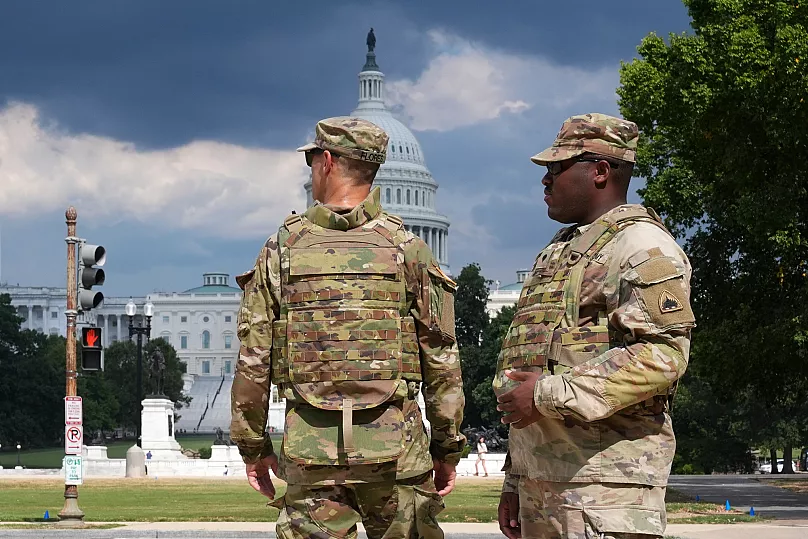

Soldiers Stationed at Landmarks, Not High-Crime Areas
WASHINGTON, D.C.: In a rare and controversial move, President Donald Trump has deployed nearly 2,000 National Guard troops across central Washington this week as part of a federal crime crackdown. However, instead of focusing on the city’s most crime-affected neighborhoods, the soldiers were stationed at major tourist attractions such as the Washington Monument, Lincoln Memorial, and the National Museum of African American History and Culture.
Out of the total force, 1,200 troops were sent from six Republican-led states. Tourists were seen mingling with uniformed soldiers patrolling the National Mall, while in high-crime areas like Ward 8 in Southeast Washington — which continues to experience some of the city’s highest homicide rates — residents reported no military presence at all.
“It’s boring. We’re not really doing much,” said Sergeant Fox of the West Virginia National Guard, posted at a quiet street corner far from any known crime hotspot.
Critics Call Deployment Politically Motivated
Local leaders and Democratic officials have questioned the motives behind the deployment. Washington Mayor Muriel Bowser voiced strong opposition, calling the operation a “show of armed force” and warning of growing militarization in the capital. Although the soldiers were unarmed at the time of observation, the Pentagon confirmed they will soon be equipped with service weapons.
Mayor Bowser stressed that the deployment appears to be more about political optics than actual crime control. “Federal law enforcement is already working in high-crime neighborhoods — this isn’t about tackling crime,” she said.
Crime statistics indicate that overall crime rates in Washington have been declining in recent years, further fueling skepticism about the necessity of the military presence.
Public Opinion Divided as Trump Signals Expansion
Reactions from the public have been mixed. In Ward 8, many residents expressed frustration. “I haven’t seen any soldiers around here — this is where they’re needed,” said Shawana Turner, a 50-year-old housing case manager. Meanwhile, some tourists in the National Mall area welcomed the increased presence. “It feels cleaner and safer,” said Anu Pokharel, a visitor from Boston.
The use of military personnel in domestic law enforcement remains an uncommon and contentious issue in the United States. Historically, the National Guard has been activated for special circumstances like presidential inaugurations and civil unrest, including the January 6 Capitol riot.
Retired Major General Randy Manner expressed concern about the precedent being set. “Not in our lifetimes has a president used uniformed soldiers to address street crime,” he said. “It’s a militarized environment — and it’s deeply troubling.”
President Trump, however, has indicated that Washington may just be the beginning. During a recent visit to a police base, he hinted at deploying similar forces to other Democratic-led cities such as Chicago and New York as part of his broader “law and order” strategy.
