

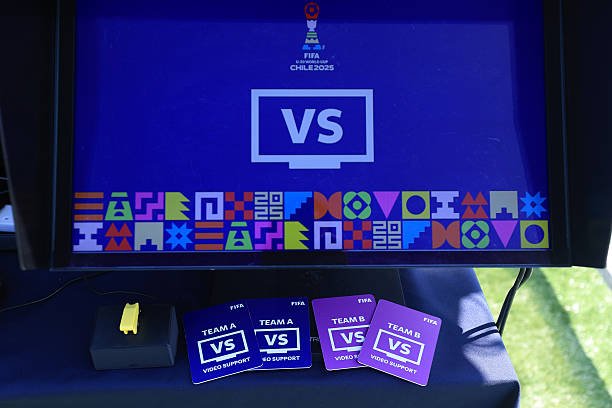

In a groundbreaking move to modernize football officiating, FIFA has introduced blue and purple cards as part of its new Football Video Support (FVS) system — a cost-effective alternative to the traditional Video Assistant Referee (VAR). This new development aims to bring fairness and technological support to tournaments and leagues that cannot afford the high infrastructure costs of full VAR setups.
What Are FIFA’s Blue and Purple Cards?
Traditionally, football relied on two card colors: yellow (warning) and red (dismissal). Now, with the rollout of FVS, blue and purple cards are being introduced not for disciplinary reasons but as review tools — one per team — to challenge critical referee decisions during a match.
-
Blue card: Held by Team A’s manager
-
Purple card: Held by Team B’s manager
Each manager receives one card at kickoff. If a controversial decision arises — such as a penalty, disallowed goal, or straight red card — a manager can hand their card to the fourth official to initiate a video review. The referee will then watch the footage using a limited number of camera angles (usually 3–4, compared to 12+ in VAR).
If the challenge results in a decision being overturned, the team retains the card and can use it again. If the original call stands, the card is forfeited.
Notably, only major incidents like goals, penalties, or straight red cards can be reviewed. Decisions such as offsides, second yellow cards, or minor fouls are not eligible for review.
Why FIFA Introduced FVS
The main motivation behind FVS is accessibility. While wealthier leagues have embraced VAR, many developing football nations and smaller leagues can’t afford the millions of dollars it takes to implement full VAR systems. FVS provides a lightweight, scalable, and affordable review mechanism using minimal technology and staff.
FIFA’s goal is to level the playing field, ensuring that even lower-tier competitions can benefit from improved officiating, without the financial strain.
Where It’s Being Used and What’s Next
The blue and purple card system has already been tested in:
-
FIFA U-20 World Cup (e.g., Morocco’s coach successfully challenged a penalty call)
-
FIFA U-17 Women’s World Cup in the Dominican Republic
-
Italy’s Serie C (men’s third division)
-
Spain’s Liga F (top-tier women’s league)
-
Spain’s Primera Federación (men’s second division)
With over 200 matches already using FVS, early reviews from officials and players have been positive, praising its simplicity and fairness.
Could This Be the Future of Football in Pakistan?
For countries like Pakistan, where full VAR implementation is currently unfeasible, FVS could offer a realistic path forward. If adopted, this system could enhance the quality of officiating in national tournaments, World Cup qualifiers, and Asian competitions, bringing credibility and fairness without straining limited budgets.
FIFA’s blue and purple card system is a revolutionary step toward democratizing access to technology in football. By prioritizing fairness, cost-efficiency, and global inclusion, this system might become a permanent fixture in global football — especially in regions that have previously been excluded from high-tech officiating tools.
It’s not just a change in how the game is played — it’s a change in who gets to play it fairly.
