

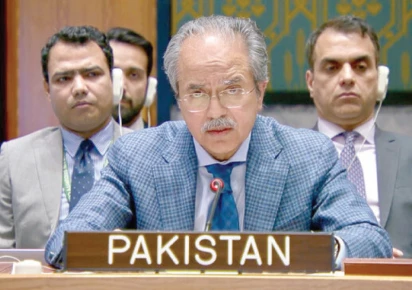

Pakistan has issued a strong warning to the United Nations about the growing threat posed by illicit weapons circulating inside Afghanistan. Islamabad stressed that these arms, many of which are advanced and left behind by foreign forces, are now being used by militant groups targeting Pakistan and destabilizing the wider region.
During the UN Security Council’s open debate on small arms, Ambassador Asim Iftikhar Ahmad, Pakistan’s Permanent Representative to the UN, highlighted that the unchecked presence of sophisticated weapons in Afghanistan is a major source of regional insecurity.
He stated that these arms “pose a direct threat to neighboring countries” and are increasingly being used by non-state actors against civilians and security forces in Pakistan.
Illicit Weapons Threaten Regional Peace
The envoy emphasized that Pakistan is seriously concerned about large stockpiles of modern arms within Afghanistan. Many of these weapons, he said, have been traced back to abandoned military supplies left after the withdrawal of foreign troops.
Weapons seized along the Pakistan-Afghanistan border have often been linked to smuggling networks and black-market sales within Afghanistan. These unmarked and unregistered weapons, according to the ambassador, enable terrorist networks and criminal gangs, undermining security across South and Central Asia.
He noted that Pakistan has credible intelligence about attempts to smuggle these weapons to neighboring states for terrorist operations. The availability of such advanced arms has emboldened groups including Daesh-K, Tehreek-e-Taliban Pakistan (TTP), Balochistan Liberation Army (BLA), and the Majeed Brigade.
“These groups have used these weapons against Pakistani civilians and security personnel, resulting in the loss of thousands of innocent lives,” he said.
Call for International Cooperation
Ambassador Ahmad urged the international community to strengthen global efforts to curb the flow of illicit arms in Afghanistan. He called on the Afghan interim authorities to fulfill their international obligations and take verifiable steps to prevent armed groups from accessing such weapons.
“The international community must close the gaps in its response and take coordinated action to address these threats,” he emphasized.
He also pointed out that the unchecked proliferation of small arms prolongs conflicts, damages socio-economic progress, and undermines peace initiatives. The envoy described small arms as “neither small nor light,” underscoring their devastating impact on human lives and regional stability.
Global Impact of Illicit Arms
Citing global terrorism data, Ambassador Ahmad noted that small arms rank as the second most used weapon in terror attacks worldwide, after explosives. He stressed that the consequences extend beyond South Asia, with Africa among the worst-affected regions.
In Africa, he explained, the illegal arms trade has intensified conflicts, promoted organized crime, and weakened the rule of law. These weapons serve as tools for terrorism and political violence, further destabilizing fragile states.
He warned that non-state actors increasingly rely on advanced, illicit arms to conduct cross-border attacks. The growing sophistication of these weapons, combined with modern smuggling tactics, poses a direct threat to national and regional security.
Emerging Technological Challenges
The ambassador highlighted new challenges emerging from the evolving nature of warfare and technological advancement. The rise of AI-based weapons, 3D-printed arms, and unmanned aerial vehicles (UAVs) has made tracking and regulating illicit arms more difficult.
He further noted that criminal networks and terrorist groups now use cryptocurrency and the dark web for anonymous transactions, making it easier to acquire illegal weapons and evade detection.
Despite these challenges, Ahmad said new technologies can also aid in arms control through enhanced monitoring, data collection, and international cooperation. He urged that traditional arms control frameworks must evolve to address these new realities effectively.
Pakistan’s Call for Balanced Action
Reaffirming Pakistan’s commitment to global arms control, Ambassador Ahmad stressed the need for a balanced approach to both the supply and demand sides of illicit weapons. He reaffirmed Pakistan’s dedication to implementing the UN Programme of Action on the Illicit Trade in Small Arms and Light Weapons, calling for its full execution at the global level.
He concluded by warning that unless the issue is addressed comprehensively, illicit arms will continue to threaten peace, security, and development in many parts of the world.
