

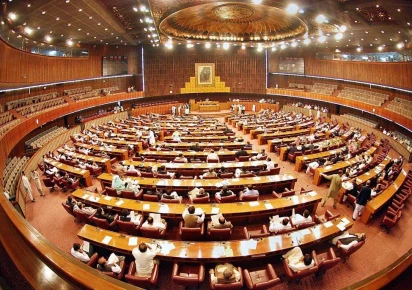

Clause-by-clause voting for the 27th Constitutional Amendment Bill began in the National Assembly on Wednesday. Law Minister Azam Nazeer Tarar presented the bill for voting in the presence of Prime Minister Shehbaz Sharif, PML-N President Nawaz Sharif, and PPP Chairman Bilawal Bhutto-Zardari.
Opposition lawmakers immediately protested near the speaker’s dais, voicing their rejection of the proposed amendment. The PML-N-led coalition government, however, holds a comfortable majority, ensuring the bill’s passage after its approval in the Senate earlier this week.
Ruling Coalition Secures Strong Majority
The government commands the numbers required for approval. In the 336-member house, the PML-N holds 125 seats, PPP 74, MQM-P 22, PML-Q five, and IPP four, alongside smaller coalition partners. Meanwhile, the opposition commands 103 seats.
If the bill secures a two-thirds majority in the Assembly, it will move to the president for final assent.
Bilawal Bhutto Condemns Terror Attacks, Defends Amendment
Amid loud protests and slogans from opposition benches, Bilawal Bhutto-Zardari condemned the recent terrorist attacks and called for national unity. He emphasized that political differences must not overshadow the fight against terrorism.
Bilawal linked the amendment to the Charter of Democracy, stating it aims to fulfill its uncompleted promises. He said the creation of constitutional courts and protection for the rank of field marshal in Article 243 were key elements.
He maintained that consensus is vital for enduring constitutional reforms, recalling the unity seen during the 18th Amendment and 1973 Constitution.
Government Ministers Slam Opposition’s “Selective Morality”
Information Minister Attaullah Tarar sharply criticized the opposition for “selective justice” and “political hypocrisy.” He argued that the PTI ignored democratic principles while in power but now opposed constitutional reform.
Tarar accused the opposition of creating chaos instead of contributing to the legislative process. He questioned their failure to offer suggestions during committee meetings and condemned their “selective memory” about past constitutional violations.
He asserted that the 27th Amendment seeks to improve governance, defense structure, and judicial efficiency — not to protect individual interests.
PPP’s Nafisa Shah Defends Party’s Role
PPP leader Nafisa Shah defended her party’s stance, stressing that many controversial clauses had been excluded from the bill due to PPP’s resistance. She highlighted that Article 163-A, which could have limited provincial financial shares, was not included.
She reaffirmed her party’s commitment to provincial autonomy and rejected proposals affecting dual nationality or executive overreach. Shah explained that the amendment aims to reform the judicial structure, including the creation of a Federal Constitutional Court (FCC), to prevent misuse of judicial powers.
According to her, Pakistan needs institutional reforms to face internal and asymmetric threats effectively, while maintaining civilian supremacy through democratic engagement.
Speaker Calls for Dialogue Between Government and Opposition
National Assembly Speaker Ayaz Sadiq urged both sides to hold constructive dialogue. He offered to facilitate talks, emphasizing that solutions come through negotiation, not confrontation.
PTI Chairman Barrister Gohar Ali Khan responded by claiming his party had always been open to dialogue but that previous efforts had failed. He reiterated calls to allow meetings with Imran Khan in jail, reflecting ongoing tensions between the government and the opposition.
Opposition Denounces Amendment as “Undemocratic”
Opposition parties under the Tehreek Tahafuz Ayeen-i-Pakistan alliance announced a nationwide protest against the bill. They described the 27th Amendment as a “dark and dangerous” move that threatens democracy.
PTI leaders claimed the bill seeks to “create another elite class” and criticized the proposal granting lifetime immunity to the president from criminal proceedings. They argued that the amendment would weaken the judiciary and erode public trust in democracy.
Government Defends Bill’s Purpose
Supporters of the amendment, including Barrister Daniyal Chaudhry, insisted that the Federal Constitutional Court would reduce the Supreme Court’s burden and prevent extra-judicial decisions.
Shazia Marri from the PPP rejected claims that the bill benefits individuals, asserting that the 18th Amendment and provincial rights remain untouched. Defence Minister Khawaja Asif also backed strengthening local governments for better governance.
Passage and Political Implications
The 27th Constitutional Amendment Bill follows last year’s 26th Amendment, which faced legal challenges and political backlash. Despite controversies, the government appears determined to advance constitutional restructuring aimed at judicial and defense reforms.
With the ruling coalition’s majority and opposition walkout, the bill’s passage seems imminent. Its long-term political and constitutional impact, however, remains a matter of intense national debate.
