

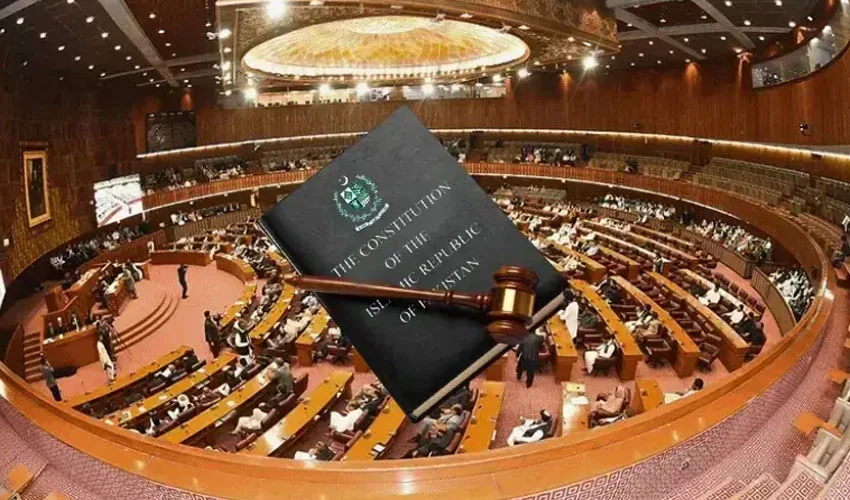

The 27th Constitutional Amendment has become the subject of a legal challenge in the Lahore High Court, where a citizen has questioned its compatibility with the Constitution of Pakistan.
The petitioner, Hassan Latif, filed the plea through Advocate Maqset Saleem, naming the Prime Minister, Speaker of the National Assembly, and the Ministry of Law among others as respondents. The petition claims that the newly passed amendment violates the fundamental spirit and balance of the Constitution.
Petitioner Claims Amendment Undermines Supreme Court Powers
According to the petition, the 27th Amendment seeks to transfer the Supreme Court’s powers to a proposed Federal Constitutional Court (FCC). The petitioner argued that such a move would drastically alter the existing judicial framework and weaken the authority of the apex court.
Furthermore, the amendment allegedly grants lifetime immunity to the Chief of Defence Staff, a provision the petitioner believes contradicts the principle of equality before the law. These clauses, he maintained, threaten the core structure of the Constitution by creating legal hierarchies that go against democratic accountability.
Plea Seeks to Declare the Amendment Unconstitutional
The petition urged the Lahore High Court to strike down the 27th Constitutional Amendment on grounds of being ultra vires — or beyond the scope — of the Constitution. It contended that the amendment violates key constitutional provisions guaranteeing the separation of powers, judicial independence, and parliamentary integrity.
The petitioner argued that the government’s actions not only disregard democratic traditions but also undermine public trust in constitutional institutions. The plea stated that the Constitution is the supreme law of the land, and no amendment should contradict its basic framework or its spirit.
Broader Context and Constitutional Implications
The challenge comes soon after the Senate approved the 27th Amendment amid heated political debates and public protests. The bill has drawn criticism from legal experts and opposition parties who believe it centralizes authority and diminishes judicial autonomy.
If the Lahore High Court admits the petition, the case could become a major constitutional test for Pakistan’s judiciary, potentially shaping the future of legislative reform and the scope of parliamentary power.
The decision will also determine whether proposed structural changes, including the creation of the Federal Constitutional Court, align with the Constitution’s core principles or distort its intent.
A Constitutional Crossroads
The court’s ruling on this matter is likely to have far-reaching implications. It may define the limits of executive authority, influence judicial reforms, and determine how far constitutional amendments can go without breaching foundational principles.
As the legal proceedings unfold, the case is expected to spark deeper national discussion on the balance of power and constitutional sanctity in Pakistan’s evolving political landscape.
