

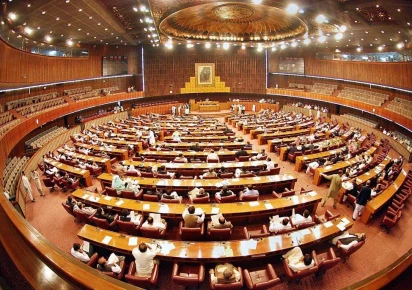

The National Assembly of Pakistan approved all 59 clauses of the 27th Constitutional Amendment Bill on Wednesday, marking a major step in the country’s ongoing constitutional reforms. The approval came amid an opposition boycott, completing the clause-by-clause voting process for the key legislation that had already been cleared by the Senate two days earlier.
The bill seeks to reshape Pakistan’s judicial and military structures, making it one of the most far-reaching constitutional overhauls in recent years. Both Prime Minister Shehbaz Sharif and Pakistan Muslim League-Nawaz (PML-N) President Nawaz Sharif attended the session in the Lower House, signaling strong government support.
Law Minister Tarar Calls Amendment “Evolutionary”
Law Minister Azam Nazeer Tarar moved the 27th Constitutional Amendment Bill in the National Assembly, stating that the amendment represents an evolutionary process in constitutional reform. He emphasized that all stakeholders were consulted, and key features had already been shared in the Senate.
Tarar clarified that Justice Yahya Afridi will continue to serve as the Chief Justice of Pakistan, addressing speculation about leadership changes following the bill’s passage. He explained that under the new arrangement, the senior-most judge between the Constitutional Court and the Supreme Court will be recognized as the Chief Justice of Pakistan (CJP).
Majority Secured in the Lower House
The bill passed smoothly, as opposition lawmakers boycotted proceedings and tore up their copies of the legislation in protest. With no votes cast against it, the 27th Amendment secured approval from 64 members in the 96-member House.
The ruling coalition’s numbers ensured an easy passage, with the PML-N, PPP, MQM-P, PML-Q, and other allied parties supporting the reform. In a surprising move, PTI-backed Senator Saifullah Abro abstained from the protest and later announced his resignation from the Senate.
Bilawal Declares “End of Suo Motu Powers”
PPP Chairman Bilawal Bhutto-Zardari said that after the passage of the 27th Amendment, the judiciary will no longer hold suo motu powers. He argued that these powers had often been misused in the past, citing instances when the judiciary intervened in administrative matters such as the regulation of basic commodities.
Bilawal remarked that the amendment marks a turning point for judicial accountability. He emphasized that previous governments had suffered from suo motu overreach, recalling instances during former Chief Justice Iftikhar Chaudhry’s tenure.
He said the establishment of a Federal Constitutional Court under the new amendment will strengthen judicial independence and bring structural balance to the legal system.
Military Reforms and New Defence Titles
The 27th Amendment also introduces significant defence-related reforms. According to the new framework, the Chief of Army Staff will assume the title of Chief of Defence Forces, with Field Marshal, Marshal of the Air Force, and Admiral of the Fleet titles designated as lifetime positions.
The Prime Minister will appoint the Field Marshal under Article 243 of the Constitution, integrating the role into the country’s defence structure with constitutional protection.
Achakzai’s Protest and Speaker’s Dialogue Offer
During the debate, Pakhtunkhwa Milli Awami Party (PkMAP) leader Mahmood Khan Achakzai denounced the government, questioning the legitimacy of the parliament formed under what he termed “Form 47 results.” In a symbolic protest, he tore a copy of the amendment bill in the assembly.
In response, Speaker Ayaz Sadiq renewed his offer of dialogue between the government and the opposition, urging political parties to engage constructively. He emphasized that continued communication could lead to consensus-based governance, saying, “Even if the first meeting yields no result, dialogue must continue.”
PTI Chairman Barrister Gohar Ali Khan welcomed the offer, reiterating that his party “never abandoned dialogue” as a democratic principle.
Government Defends Bill, Opposition Faces Criticism
Information Minister Attaullah Tarar criticized the opposition for rejecting the bill, accusing them of double standards. He argued that opposition parties supported centralized power while in government but now opposed parliamentary procedures. Tarar stated that Parliament alone holds the authority to amend the Constitution, not the judiciary.
He also rejected the opposition’s repeated references to “Form 47,” calling it an excuse to discredit legitimate constitutional reform.
Key Highlights of the 27th Constitutional Amendment
-
Chief of Army Staff to assume role as Chief of Defence Forces
-
Lifetime military titles for Field Marshal, Marshal of Air Force, and Admiral of Fleet
-
Federal Constitutional Court to be established
-
Equal provincial representation in the new court
-
FCC empowered to take suo motu notice upon petitions
-
Islamabad High Court to have one judge on the FCC bench
-
President and Prime Minister to oversee judicial appointments
-
Supreme Court powers reduced, with some transferred to FCC
-
Limited presidential immunity for post-tenure public office
-
High court judges must serve five years before FCC eligibility
-
Judicial Commission to manage transfers
-
Supreme Judicial Council to review transfer objections
Towards a New Constitutional Order
The passage of the 27th Constitutional Amendment Bill marks a historic phase in Pakistan’s constitutional evolution. While supporters view it as a progressive step towards balanced governance and institutional reform, critics argue it could centralize authority and alter judicial independence.
As the bill heads for final approval procedures, Pakistan enters a new chapter in its constitutional and political transformation, testing the strength of its democratic institutions and legislative consensus.
