

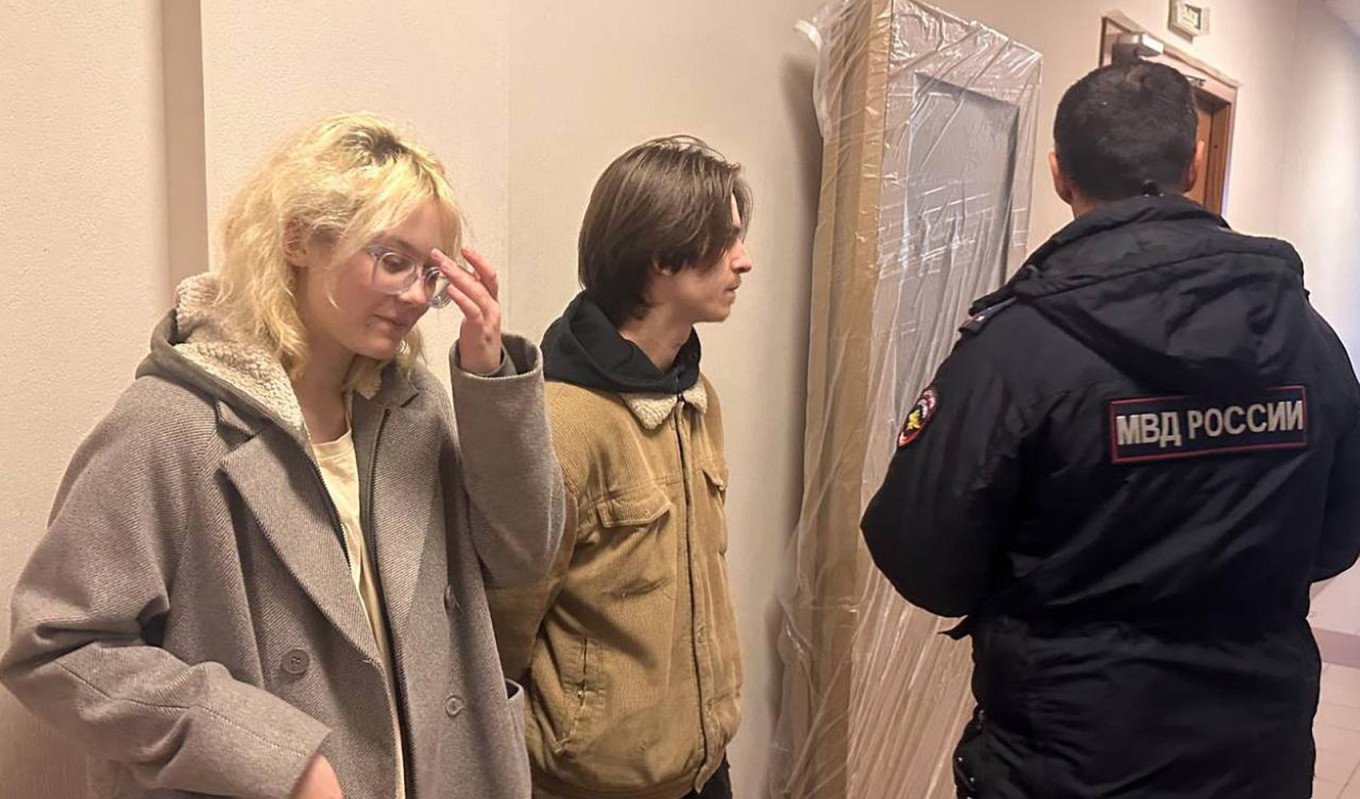

A System Designed to Keep Detainees Locked Away Without Charges
The practice of “carousel arrests” — where detainees are placed under consecutive administrative sentences to prevent their release — continues to spread across Russia, affecting activists, musicians, and political opponents alike. Legal experts and human rights groups warn that these repeated arrests, which require no criminal charges, have become one of the state’s most effective tools for suppressing dissent.
Recent cases, including the repeated detention of St. Petersburg street musician Diana Loginova and her bandmates, illustrate the growing reliance on this tactic. But the phenomenon is neither new nor isolated. According to OVD-Info, Russian law imposes no limit on how many consecutive administrative arrests a person may serve, creating a loophole that authorities can exploit indefinitely. The rights group describes the practice as a clear form of arbitrary detention and a violation of international legal standards.
One of the most tragic cases is that of Rostov activist and musician Anatoly Berezikov, who died while serving his third consecutive administrative sentence in 2023. Activists believe his real “offense” was distributing flyers for the Ukrainian project Hochu Zhit (“I Want to Live”), which assists Russian soldiers who wish to surrender to Kyiv. His death sparked outrage, with many fearing he may have been tortured during detention.
A Tool for Buying Time — or Blocking Protest Movements
Human rights advocates identify two main motives behind carousel arrests. The first is strategic: detaining a person repeatedly gives authorities time to gather evidence for a potential criminal case or to access personal information. While detainees are held, police may search their homes, extract data from their devices, pressure their relatives, or intimidate their associates — all before launching formal charges.
The second motive works in the opposite direction. Instead of preparing a criminal case, authorities may use repeated short-term arrests simply to keep someone off the streets during moments of political tension. In 2018, the late opposition leader Alexei Navalny spent 50 consecutive days under administrative arrest, preventing him from attending protests against the Kremlin’s pension reform. Formally, he was arrested for repeated violations of protest rules; practically, the aim was to silence him during a critical period.
A year later, during the 2019 Moscow City Duma elections, opposition figures including Ilya Yashin, Dmitry Gudkov, and Yulia Galyamina were arrested repeatedly to keep them from participating in demonstrations against the exclusion of anti-Kremlin candidates.
The members of Pussy Riot faced a similar ordeal in 2021. Maria Alyokhina, Veronika Nikulshina, Alexander Sofeev, and Anna Kuzminykh were detained multiple times in succession — a pressure campaign activists say was meant to push them out of the country. Nikulshina was initially detained on the pretext of preventing “provocations” ahead of Victory Day celebrations, then re-arrested twice more for allegedly disobeying police orders.
Sofeev later described the psychological toll of consecutive detentions: “You think it’s just a short period and you’ll get through it. But when it happens again and again, you realize you can no longer control your life or even know when your arrests will end.” He fled Russia shortly after his release, noting that today’s crackdown is even harsher: detainees are often re-arrested the moment they step out of the holding cell.
OVD-Info has launched a petition demanding legal reforms, warning that unlimited consecutive arrests give security forces “a convenient mechanism for arbitrary detention” and obstruct fundamental rights. The group has urged the Prosecutor General’s Office and Russia’s human rights commissioner to investigate the ongoing arrests of Stoptime’s musicians.
Loginova, who has not been released between detentions, remains jailed until Nov. 24. Guitarist Alexander Orlov is also still in custody, while drummer Vladislav Leontyev was freed after his second arrest. Whether they will face further detentions — or escalation to criminal charges — remains unknown.
In response, supporters across Russia have begun staging solo pickets and public musical performances to demand the musicians’ release. Many remain fearful that the cycle of arrests will continue indefinitely.
“I still hope this will be their last arrest,” Sofeev said. “What’s happening is unbearable to watch.”
