

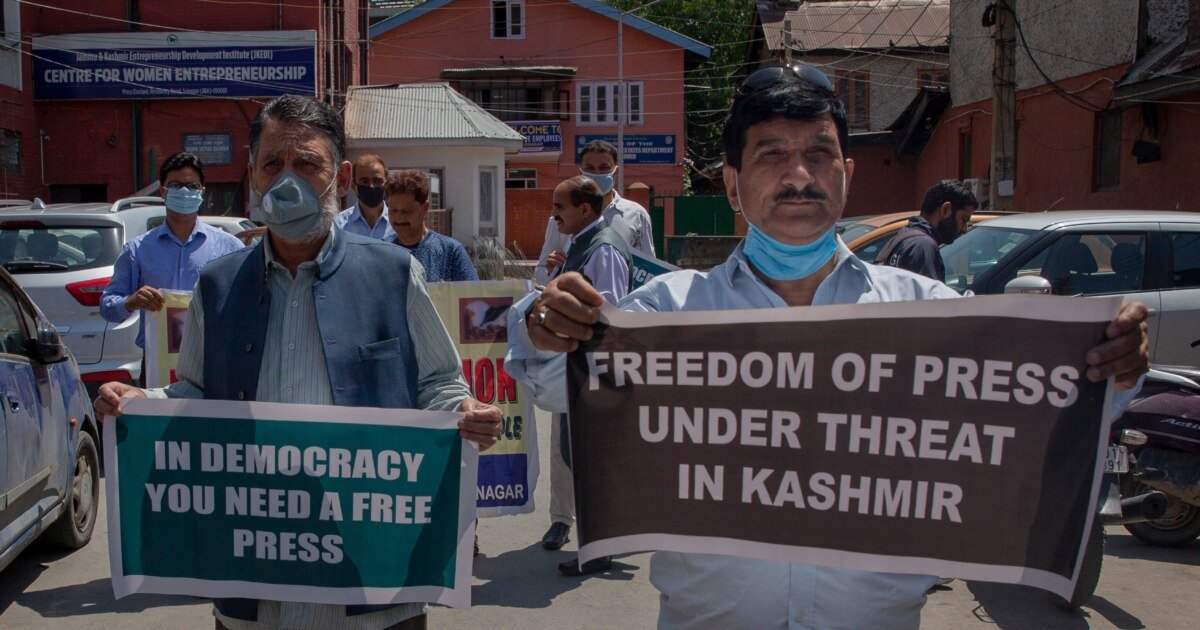

SIA Targets Kashmir’s Oldest English Newspaper in Widening Media Crackdown
Indian authorities raided the office of Kashmir Times, the oldest English-language news outlet in India-occupied Kashmir, as part of an ongoing crackdown on media accused of promoting “anti-national” or “separatist” narratives, Indian media reported. The State Investigation Agency (SIA) conducted the raid early Thursday, following an FIR that alleged the organisation’s involvement in activities considered harmful to the “sovereignty and integrity of India”.
According to The Indian Express, the FIR cites communications and material under scrutiny for supposedly aiding separatist views. SIA officials entered the newsroom at 6am after calling the newspaper’s manager to unlock the premises. They examined documents, digital equipment, and archived content, and officials indicated that senior editor Anuradha Bhasin is likely to be questioned as part of the probe.
The SIA claims the operation is part of broader action against networks believed to support separatist messaging. The agency stated that no media platform would be allowed to propagate what it considers seditious or anti-national content.
Kashmir Times Editors Call Raid an Attempt to Silence Independent Journalism
Editors Prabodh Jamwal and Anuradha Bhasin strongly condemned the raid, calling it a “coordinated attempt to silence us.” They rejected the accusations as “baseless” and stressed that criticising the government is not equivalent to undermining the state. They argued that a free, questioning press strengthens democracy by holding authorities accountable and giving space to marginalised voices.
In their statement, the editors said Kashmir Times, in circulation since 1954, has always practiced independent journalism. They asserted that they are being targeted precisely because they continue to “speak truth to power” while many critical voices in the region have already been silenced. The newspaper’s Srinagar office was previously sealed in 2020, and its print edition was forced to shut down in 2021 before the outlet shifted entirely to digital operations.
They urged authorities to withdraw “unfounded allegations” and appealed to civil society and fellow journalists to recognise the threat to press freedom. “Journalism is not a crime,” they said, adding that state power cannot “raid our commitment to the truth”.
International and Regional Bodies Condemn Raid, Cite Alarming Decline in Press Freedom
The Committee to Protect Journalists called the raid “deeply troubling” and demanded that authorities return any seized material. CPJ urged India to explain the legal basis of the action and conduct any investigation transparently. Bhasin told CPJ she was unaware of any FIR filed directly against her and clarified that the Jammu office, shut since 2022 due to financial constraints, contained only outdated equipment and archival material.
Press bodies in Azad Jammu and Kashmir also condemned the raid. The Muzaffarabad Central Press Club and the Capital Journalists Forum described the move as part of a “systematic campaign” to suppress independent journalism in the occupied region. They warned that silencing the few remaining free voices undermines democratic values and restricts public access to information.
AJK Prime Minister Faisal Mumtaz Rathore denounced the raid as an attempt to suppress reporting on human rights violations in occupied Kashmir. He said India is trying to silence voices advocating Kashmiris’ UN-recognised right to self-determination and urged international human rights groups to intervene.
Press freedom in India-occupied Kashmir has been increasingly restricted. Under Prime Minister Narendra Modi, media rights across India have deteriorated, with the country ranked 142nd on the global press freedom index in 2020 — below Afghanistan and Zimbabwe.
