

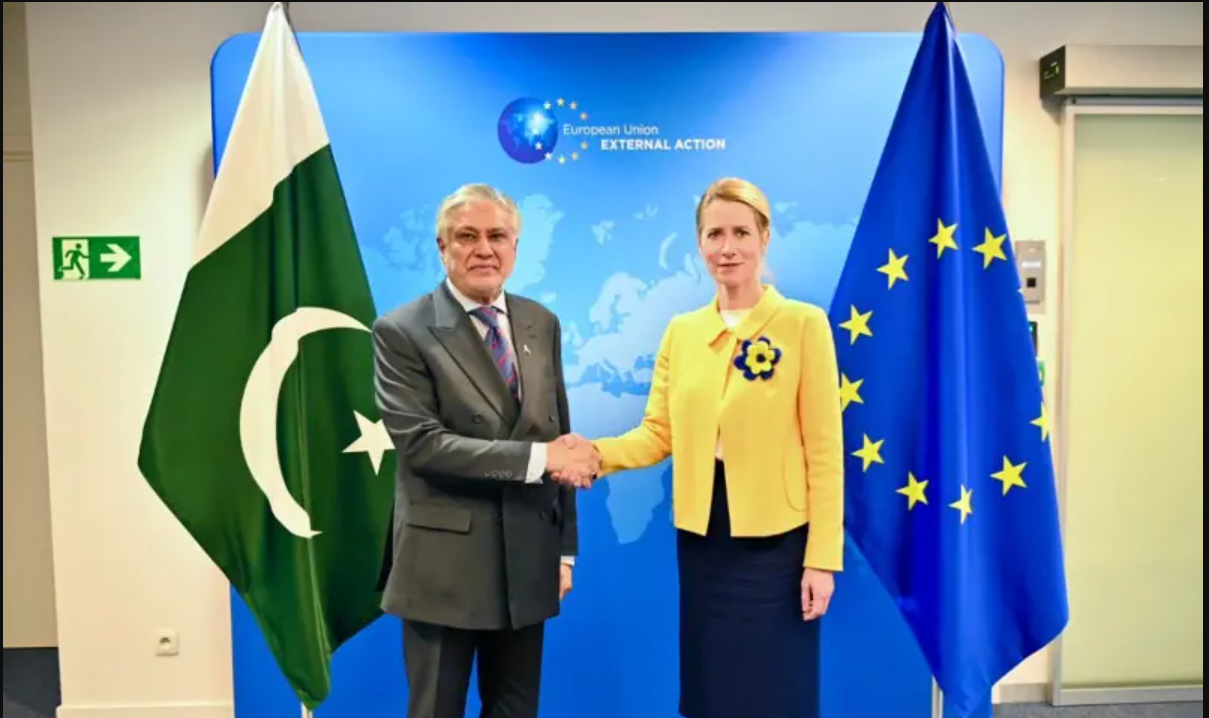

Pakistan and the European Union (EU) held the seventh round of the Strategic Dialogue in Brussels. The meeting was co-chaired by Pakistan’s Deputy Prime Minister and Foreign Minister Ishaq Dar, and the EU’s High Representative for Foreign Affairs Kaja Kallas. Discussions focused on strengthening bilateral ties and reviewing the EU-Pakistan Strategic Engagement Plan (SEP) from 2019.
Commitment to Deepen Cooperation
Both sides agreed to enhance collaboration across all areas covered under the SEP. Their objective is to align strategic priorities and support sustained development in trade, migration, human rights, and economic policies. They highlighted knowledge-sharing initiatives, including Erasmus Mundus and Horizon Europe programs, while jointly addressing challenges related to food security, energy, and climate change.
Trade and Economic Partnerships
Pakistan and the EU reaffirmed commitment to promoting sustainable trade and growth. Leaders emphasized the Generalised Scheme of Preferences (GSP+), noting its importance in strengthening economic relations. The dialogue also highlighted the need for multilateral cooperation, adherence to the UN Charter, and a rules-based international order to maintain peace and prosperity.
Global Conflicts and Peace Efforts
The dialogue addressed the situation in the Middle East. Both sides welcomed the first phase of the Comprehensive Plan to resolve the Gaza conflict. They stressed adherence to the ceasefire and full implementation of the agreement, alongside humanitarian support, governance, and reconstruction efforts. Furthermore, they expressed support for a two-state solution based on relevant UN resolutions.
Focus on Afghanistan and Regional Stability
Discussions also included Pakistan-Afghanistan relations amid cross-border tensions in October 2025. Both sides called on Afghanistan’s de facto authorities to play a constructive role in eliminating terrorism from Afghan soil. They urged efforts to maintain regional peace, promote prosperity, and resolve issues through dialogue.
The ministers also expressed concern over Afghanistan’s socio-economic challenges. They supported a stable, self-reliant Afghanistan, advocating for a credible political process aligned with the UN-led Doha process and commitments made by the Taliban de facto authorities.
Humanitarian Concerns and Afghan Refugees
Pakistan’s hosting of millions of Afghan nationals over decades was acknowledged, with the EU emphasizing that any repatriation must be safe, dignified, and in accordance with international standards. The dialogue highlighted the protection of human rights, particularly for women, girls, and vulnerable communities in Afghanistan.
Next Steps in Strategic Dialogue
At the conclusion of the discussions, both Pakistan and the EU agreed to convene the eighth round of the Strategic Dialogue in Islamabad. The upcoming talks are expected to further strengthen cooperation on regional security, trade, and humanitarian efforts.
