

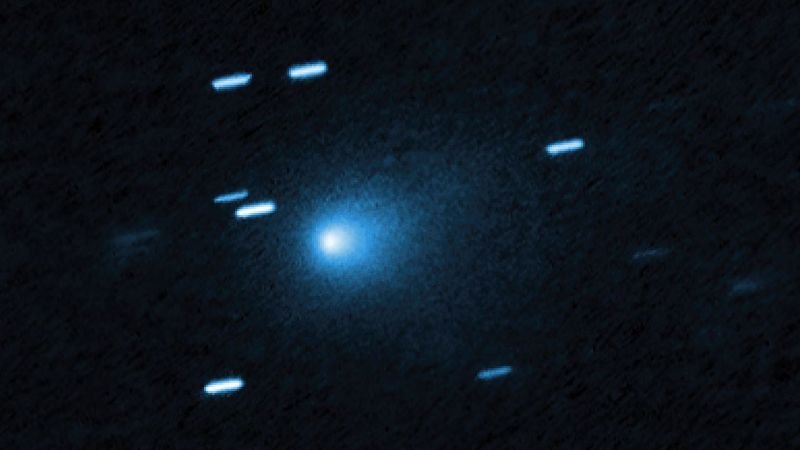

Scientists have tracked interstellar comet 3I/ATLAS as it vented water following its late-October perihelion, using data from NASA’s Solar and Heliospheric Observatory (SOHO). Observations from the SWAN instrument revealed the comet’s hydrogen coma starting on November 6, nine days after closest approach to the Sun.
By modeling the ultraviolet hydrogen glow, which arises as sunlight breaks apart water molecules, researchers estimated a peak water production rate of 3.17 × 10²⁹ molecules per second at 1.40 astronomical units (AU) from the Sun, declining to 1–2 × 10²⁸ molecules per second by December 8.
These measurements help scientists understand how quickly an interstellar comet “winds down” after solar heating and whether it behaves like typical solar-system comets.
Meanwhile, a Breakthrough Listen radio search using the 100-meter Green Bank Telescope scanned frequencies from 1 to 12 gigahertz on December 18. The survey reported no candidate technosignatures—potential signs of artificial transmissions—down to a 100-milliwatt sensitivity level.
All signals detected were traced to human-made radio interference. The null result adds evidence that 3I/ATLAS is behaving like an ordinary comet, countering online speculation about potential non-natural origins, including claims by Harvard astrophysicist Avi Loeb regarding jets and sunward anti-tail features.
The comet, only the third confirmed interstellar object entering the solar system, passed safely no closer than 1.8 AU from Earth, traveling at up to 210,000 km/h relative to the Sun. Its nucleus is estimated to be between roughly 440 meters and 5.6 kilometers, reflecting observational uncertainties.
Scientists note that both ultraviolet water estimates and radio searches have limitations, but the combined data provide a clearer picture of a fast-moving interstellar visitor shedding water and behaving as expected for a comet as it returns to interstellar space.
