

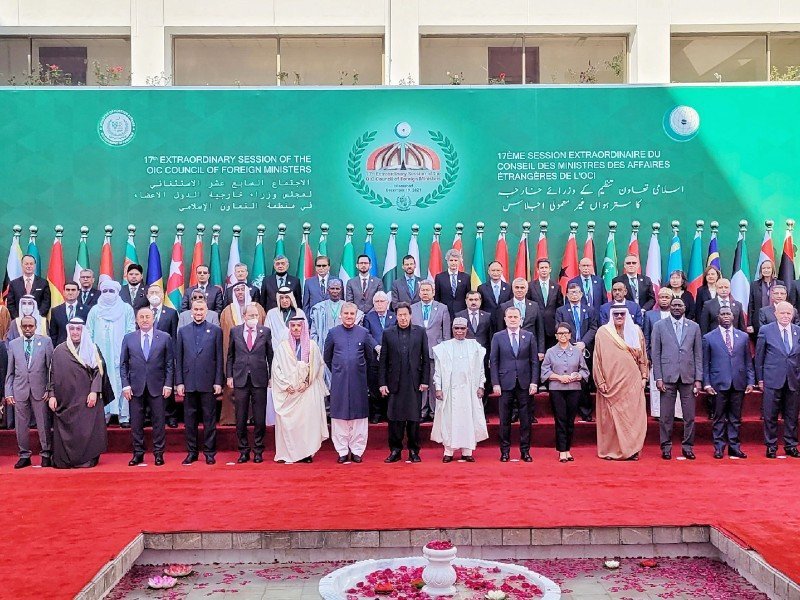

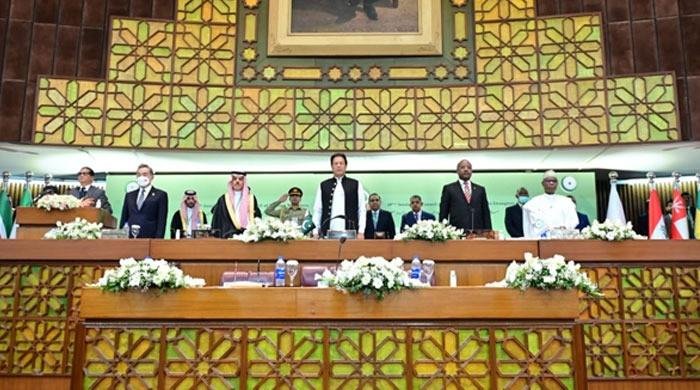
ISLAMABAD: The 48th session of the OIC Council of Foreign Ministers (CFM) concluded with Islamabad Declaration, which was issued by the member states with the resolve to pursue a shared global vision for peace, security, development and human rights based on a faithful commitment to the universal principles of equity and justice, sovereign equality, territorial integrity and non-interference in the internal affairs of countries.
The OIC Council also vowed to raise causes of Kashmiris and Palestinians to protect their fundamental rights and ensure freedom for them.
The Organisation of Islamic Countries (OIC) member states have praised Pakistan for playing a vital role as an anchor of stability in South Asia and its efforts for promoting regional peace in the subcontinent.
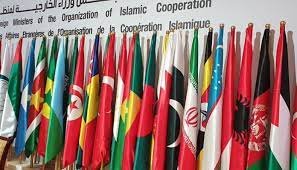
Meanwhile, the OIC Contact Group on Jammu and Kashmir has adopted a comprehensive joint communique including an action plan on the Kashmir issue to contemplate greater coordination between the member states.
This plan will involve joint efforts by the member states to lead the outstanding Kashmir dispute towards a peaceful resolution under the UN resolutions.
Under this plan, the OIC countries will raise the Kashmir issue in their bilateral engagements with India and underscore respect for the fundamental human rights of the Kashmiri people, as well as lend support to monitor human rights violations in the Indian Occupied Jammu and Kashmir (IOJK).
They will also coordinate their positions on peace and security, human rights and humanitarian dimensions of IOJK at the United Nations (UN) and other international platforms.
Moreover, the OIC Secretary-General will also raise the Kashmir issue separately in engagements with international, regional, human rights organisations and various other interlocutors.
“We condemn massive violations of their human rights in the Indian Illegally Occupied Jammu and Kashmir (IIOJK). We reiterate rejection of India’s illegal and unilateral actions since Aug 5, 2019, aimed at altering the demographic composition of the occupied territory, suppressing the realisation of the inalienable right to self-determination of the Kashmiris in violation of UN Security Council resolutions, and international law, including the Fourth Geneva Convention.” This was stated at the conference of the CFMs.
The member states declared that the final settlement of the Jammu and Kashmir dispute in accordance with UN Security Council resolutions was indispensable to durable peace in South Asia.
“We reiterate our call on India to reverse its unilateral and illegal measures instituted since Aug 5, 2019, cease its oppression and human rights violations against the Kashmiris in Indian Illegally Occupied Jammu and Kashmir, halt and reverse attempts to alter the demographic structure and redraw electoral constituencies in IIOJK and take concrete and meaningful steps for full implementation of the UN Security Council resolutions on Jammu and Kashmir.”
The member states also reaffirmed their strong position against any attempts to equate the just and legitimate struggle of people for self-determination and liberation from foreign occupation with terrorism.
They rejected terrorism in all forms and manifestations as well as attempts to attribute terrorism to any country, religion, nationality, race or civilisation.
OIC condemns launch of supersonic missile by India
Apart from the Kashmir issue, the OIC member states while taking note of an Indian missile that landed inside Pakistan expressed its grave concern over the violation of Pakistan’s airspace, threat to passenger aircraft and dangers to peace and security in South Asia arising from the launch of a supersonic missile on March 9, 2022.
They called on India to “fully abide by international law and norms of responsible state behavior and conduct a joint probe with Pakistan to accurately establish facts.”
The member states denounced the systematic and widespread policy of discrimination and intolerance against Muslims in India, which has led to their political, economic and social marginalisation.
“We are deeply alarmed by the most pernicious attacks on the Muslim identity in India as manifest in the discriminatory laws and policies targeting the Hijab. We call upon India to immediately revoke such discriminatory laws, ensure the rights of the Indian Muslims and protect their religious freedom.”
Palestine issue
Moreover, the conference re-emphasised the centrality of the question of Palestine and Al-Quds Al-Sharif for the Muslim Ummah, reaffirming its principled and continued all-level support to the Palestinian people to regain their inalienable legitimate national rights, including their right to self-determination and the independence of the State of Palestine along the 1967 borders, with Al-Quds Al-Sharif as its capital. “We also reaffirm our duty to protect the right of Palestinian refugees to return to their homes in accordance with UN General Assembly resolution 194 and to unequivocally counter any denial of these rights.”
They reaffirmed that Al-Quds Al-Sharif is an integral part of the occupied Palestinian Territory of the State of Palestine and called on the international community to compel Israel, the occupying power, to desist from its colonial practices and abide by all international resolutions on the City of Al-Quds Al-Sharif, and to refrain from all measures, practices and decisions aimed at altering the character and legal status of the Holy City, including through intensification of Jewish colonial settlements therein and forcible expulsion of its Arab Palestinian inhabitants; and to desist from the desecration of Islamic Shrines, including aggression against Al-Quds Al-Sharif and call for mobilisation of all efforts to confront Israeli colonial occupation and hostile takeover of the Holy City and to support the steadfastness of the Palestinian people as well as reiterate that maintaining Jerusalem’s legal status as the Capital of the State of Palestine is the only guarantee to achieving peace and security for the region.
“We decide to take further effective measures to remove obstacles to the realisation of the Palestinian people to self-determination, through ensuring protection and bringing an end to Israelis’ illegal colonial occupation and apartheid regime, and for achieving a just solution. In this regard, we decide to seek accountability measures against the occupying power, and to lend full support to and cooperation in all actions that seek accountability and are aimed at bringing an end to this colonial occupation and its apartheid regime, including at the ICJ.”
