


France upholds ban
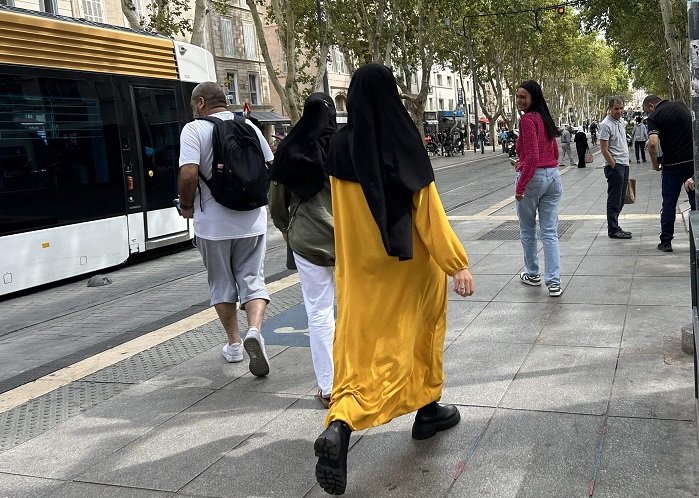
France’s top court upheld the government’s ban on wearing abaya, a traditional over-garments Muslim girls wear in schools. The court rejected complaints that it was discriminatory decision and could incite hatred.
President Emmanuel Macron’s government had announced the ban on the abaya in schools last month. He cited it as a violation of the rules on secularism in education. The ban on Muslim headscarves had already been implemented on the grounds that they displayed religious affiliation.
An association representing Muslims filed a motion with the State Council, France’s highest court for complaints against state authorities. Association sought an injunction against the ban on the abaya and the ‘Kameez’, its male equivalent.

France upholds ban on abaya.
The association argued that the ban was discriminatory and could incite hatred against Muslims.
However, after a two-day examination of the motion filed by the Action for the Rights of Muslims (ADM), the State Council rejected the arguments. It stated that wearing the abaya “follows the logic of religious affirmation”.
The Council argued that the decision was based on French law. It prohibits the display of visible signs of any religious affiliation in schools.
The State Council also concluded that the ban did not cause “serious or obviously illegal harm to the respect for personal lives. It also did not affect freedom of religion, the right to education, the well-being of children.”
Before the ruling, France’s Council of the Muslim Faith (CFCM) had expressed concerns. It said that banning the abaya could increase the risk of discrimination. The CFCM suggested it might file its own complaint with the State Council. They argued that the absence of a clear definition of Abaya created ambiguity and legal uncertainty.
During the court hearing, ADM’s lawyer, Vincent Brengarth, contended that the abaya should be considered a traditional garment, not a religious one. He also accused the government of using the ban for political gain.
ADM president Sihem Zine criticized the rule as “sexist” because it targeted girls and singled out Arabs.
In response, the education ministry argued that the abaya made its wearers “immediately recognizable as Muslims.” It is contrary to France’s secular culture.
On the first day of the school year, French schools sent dozens of girls home for refusing to remove their abayas. Education Minister Gabriel Attal said 300 schoolgirls defied the ban. However, 67 students refused and were sent home.
In 2016, the State Council overturned a ban on the burkini in a French Riviera resort, stating that it did not pose a threat to public order. Official estimates suggest that around 10 percent of France’s 67 million inhabitants are Muslim.
