

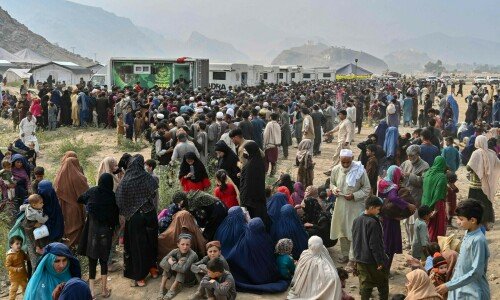

The government of Pakistan is set to establish three additional crossing points along the Afghanistan border, aiming to facilitate the prompt repatriation of illegal Afghan immigrants. Officials have notified the Afghan government that these new crossings will become operational starting today.
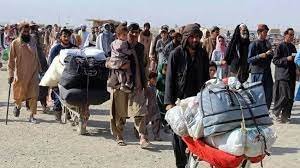
In a related development, a report from the Sindh Home Department has characterized illegal immigrants as a security concern, warning that the provincial demographic landscape could undergo a significant transformation by 2040 if immediate repatriation measures are not taken.
Concerning the new crossing points, government sources have disclosed plans to open one in the Badini-Shinband area of Qila Saifullah and two in the Brabcha and Noor Wahab areas of Chagai district.
The existing Chaman border crossing has been strained due to an overwhelming influx of illegal immigrants, prompting the proposal for these additional crossing points. The Federal Investigation Agency (FIA) and other involved departments have encountered challenges in processing and registering migrants from various regions in Balochistan and other provinces.
Details reveal that immigrants from Zhob, Loralai, Sherani, and nearby areas will be repatriated through the Badini-Shinband crossing, with the Qila Saifullah assistant commissioner appointing a Levies officer in Badini to oversee the repatriation process. Meanwhile, individuals from Noshki, Chagai, Kharan, Washuk, and the coastal district of Gwadar will be directed to Afghanistan through the other proposed crossing points.
Official data indicates that 88,000 illegal Afghan nationals have voluntarily returned from the Chaman border crossing, with 3,173 refugees returning on a single day from the Chaman holding centre.
Labeling illegal immigrants as a security threat, the Sindh government’s report emphasizes that the province has been significantly affected by the influx of illegal foreigners over the past four decades. The unchecked arrival has strained the province’s limited resources, and if the trend continues, it may exacerbate an already precarious situation.
The report cites a large number of Afghan nationals, both documented and undocumented, residing in Sindh. While 73,000 have Proof of Registration cards, and 68,000 possess Afghan Citizen Cards, there are also hundreds of thousands of unregistered illegal Afghans, Burmese, and Bengalis. The report claims that many of these illegal foreigners are involved in criminal activities such as street crime, robberies, murders, narcotics, and illicit and terrorist activities.
Quoting discussions from the 25th Provincial Apex Committee meeting in 2021, the report underscores the urgency of addressing the influx of illegal settlers to prevent a complete demographic change in Karachi by 2040.
