

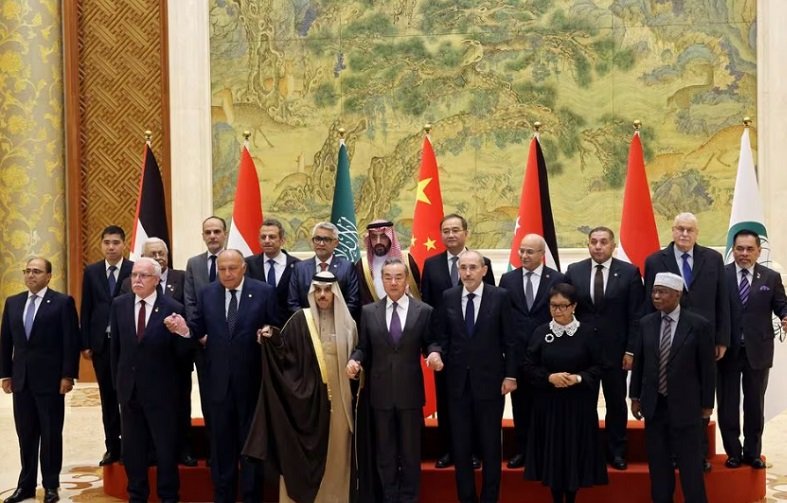

In Beijing, Arab and Muslim ministers jointly appealed for an immediate ceasefire in Gaza during the first leg of their diplomatic tour, urging an end to hostilities and the facilitation of humanitarian aid into the severely affected Palestinian enclave.
The delegation, scheduled to meet officials from each of the UN Security Council’s permanent members, is also exerting pressure on Western nations to reject Israel’s assertion of self-defense as justification for its actions against Palestinians.
Ministers from Saudi Arabia, Jordan, Egypt, Indonesia, Palestine, and the Organisation of Islamic Cooperation, among others, engaged in discussions with China’s top diplomat Wang Yi.
Saudi Foreign Minister Prince Faisal bin Farhan Al Saud emphasized the urgent need to halt violence and killings while immediately providing humanitarian assistance to Gaza.
This call for a ceasefire follows an extraordinary joint Islamic-Arab summit in Riyadh, where leaders urged the International Criminal Court to investigate alleged “war crimes and crimes against humanity” committed by Israel in Palestinian territories.
Saudi Arabia has actively sought the United States and Israel’s cooperation to end hostilities in Gaza, with Crown Prince Mohammed bin Salman mobilizing Arab and Muslim leaders to reinforce this message.
The Israeli ambassador to Beijing, Irit Ben-Abba, expressed hope that the delegation would focus on the release of hostages captured by Hamas and underscored the importance of joint discussions on Egypt’s role in facilitating humanitarian aid.
Chinese Foreign Minister Wang Yi emphasized Beijing’s steadfast support for the just cause of the Palestinian people and pledged to work toward ending the conflict, alleviating the humanitarian crisis, and promoting a comprehensive and lasting resolution to the Palestinian issue.
China, positioning itself as a “good friend and brother” to Arab and Muslim nations, has consistently advocated for de-escalation and a “two-state solution” amid the ongoing hostilities.
China’s diplomatic efforts in the Middle East, underscored by its special envoy Zhai Jun, reflect its broader strategy to strengthen alliances and counter Western influence.
