

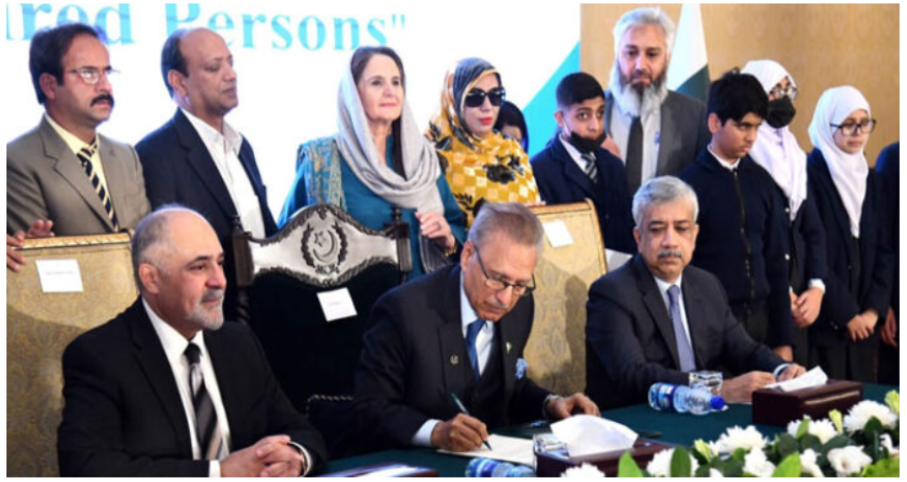

On Tuesday, Pakistan officially became a participant in the Marrakesh Treaty, a significant international agreement designed to enhance access to published works for individuals with visual impairments. President Dr. Arif Alvi endorsed the instrument of accession to the Marrakesh Treaty, administered by the World Intellectual Property Organization (WIPO), during a special ceremony at Aiwan-e-Sadr.
The Marrakesh Treaty, initiated in Morocco on June 27, 2013, and adopted by numerous countries globally, focuses on facilitating access to books and literary content for those with visual or print disabilities. It permits the reproduction of published materials into accessible formats like braille, large print, and audio editions.
By joining the Treaty, Pakistan aims to offer approximately 10 million visually impaired individuals in the country easier access to published materials. Previously, restrictions stemming from the Copyright Ordinance of 1962 limited the provision of compulsory printing and reproduction of braille and audio versions.
President Alvi expressed immense pride in Pakistan’s accession to the Marrakesh Treaty, emphasizing that it marks a significant step toward empowering visually impaired citizens. He highlighted the Treaty’s role as an equalizer, providing equitable access and opportunities for visually challenged individuals.
According to President Alvi, the Treaty will create an environment conducive to learning and equal opportunities, particularly in education and employment, for this often-neglected segment of society. He emphasized the state’s responsibility to accommodate differently-abled citizens and ensure their inclusion in all aspects of life.
President Alvi noted that breaking the taboo around persons with disabilities is crucial, emphasizing that accommodating them is not a favor but a right owed to them by society. He commended Pakistan’s recent success in challenging taboos about differently-abled individuals, citing adherence to World Health Organization guidelines for addressing their needs in health, education, and employment.
President Alvi highlighted the achievements of visually impaired diplomat Saima Saleem, who represented Pakistan at the United Nations. He expressed confidence in the positive impact of artificial intelligence-based technology in assistive gadgets and smart devices, offering visually impaired persons a brighter future.
The president acknowledged the efforts of his wife, Samina Alvi, in advocating for differently-abled individuals and praised the Ministry of Human Rights for taking the initiative to accede to the Marrakesh Treaty for visually impaired persons.
