

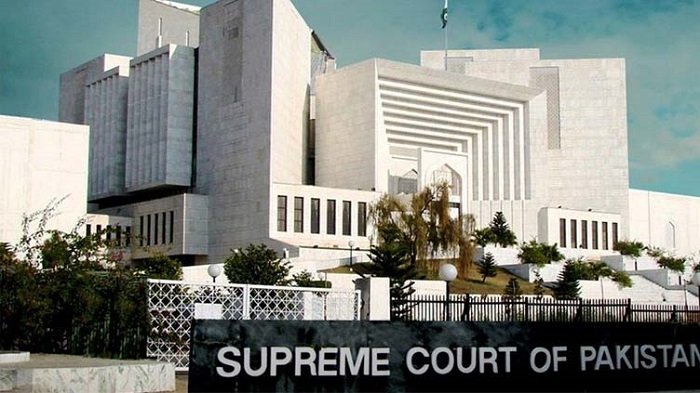

The Supreme Court has reserved its verdict on a petition seeking a suspension of its earlier ruling that paused civilian trials in military courts.
The Supreme Court resumed hearings on intra-court appeals challenging its verdict against trying civilians in military courts. Head of the bench, Justice Sardar Tariq Masood, declined to step down despite objections from one of the applicants.
The six-member larger bench, presided over by Justice Masood, includes Justices Aminuddin, Hassan Azhar Rizvi, Muhammad Ali Mazhar, Musarrat Hilali, and Irfan Saadat.
The appeals were filed by the federal and provincial governments, along with the Defence Ministry. The federal government sought a stay on the court verdict and appealed to declare the decision null and void.
Former Chief Justice of Pakistan Jawad S Khawaja, an applicant, raised concerns about Justice Masood’s inclusion in the bench, citing reservations over his prior opinions on military court applications. Khawaja proposed forming a new bench through the judges’ committee.
The petition highlighted that both Chief Justice Qazi Faez Isa and Justice Masood had recused themselves from a nine-member bench that previously heard these cases. Justice Masood’s earlier opinion, dated June 26, had declared the petitions against military courts inadmissible.
The Hearing
At the commencement of the hearing, Justice Masood, unyielding to the applicant’s objections, refused to step down from the bench, asserting that the decision to recuse was within a judge’s prerogative, as previously established by the applicant. Despite the former CJP’s protest, Justice Masood stood firm, stating, “Pardon me, but I do not step down from the bench.”
Khawaja Haris, the Defense Ministry’s lawyer, began presenting arguments and recited the court verdict. Justice Masood interjected, noting that the entire section of the law had been declared invalid succinctly in two lines.
Haris countered, mentioning that these provisions had been upheld in previous Supreme Court decisions. He pointed out that an eight-member bench had retained these provisions in the FB Ali case. However, in the recent decision, a majority vote of 4-1 declared the provisions null and void. Haris added that these provisions were also maintained in the 21st Constitutional Amendment case.
