


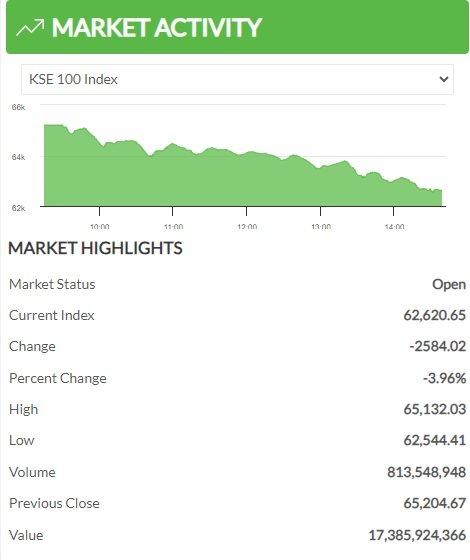
ISLAMABAD: The Pakistan Stock Exchange (PSX) crashed on Tuesday as the KSE-100 index lost more than 2500 points during intraday trading.
Initially, the bourse remained stable for 10 minutes post the opening bell as per the PSX website.
However, at 10:49 am, a gradual downturn commenced, witnessing the KSE-100 index plummeting by 2580 points. The benchmark index fell to 62,620 points till 2:40 pm.
The previous day saw a 925.35-point dip in the benchmark shares due to profit-taking among investors, particularly impacted by negative performances in exploration, production, fertilizers, and banking sectors.
The stock market analysts linked this bearish trend to “escalated geopolitical tensions” driving a surge in global oil prices.
They noted the recent 3% hike in global oil prices due to heightened attacks by the Iran-aligned Yemeni Houthi militant group in the Red Sea, causing disruption in maritime trade.
This upheaval in oil trade significantly affects countries like Pakistan, heavily reliant on oil imports.
Analysts predicted a corrective phase in the market until the end of December, identifying a crucial support level at 64,500, advising investors to proceed with caution.
Margin calls, a common occurrence in volatile markets, mandate investors to either sell their stock positions or infuse additional cash into their accounts if the equity falls below the maintenance margin.
Banks lend Rs 861 billion for auto financing in three months
Meanwhile, in the last three months, Pakistani banks have provided a record 861 billion rupees amount as loans for auto financing in just three months, Sept-Nov 2023.
In November 2023, auto financing in Pakistan fell to Rs257 billion, marking a 24.43% yearly and 2.64% monthly decline from Rs340 billion in November 2022 and Rs264.03 billion in October 2023, respectively, according to the latest data from the central bank.
This downward trend, the seventh consecutive monthly drop, is primarily linked to higher interest rates, increased car prices, stricter loan acquisition regulations, and elevated taxes on automobile imports and parts.
Consumer financing for home construction reached Rs207 billion by November’s end, down 3.15% yearly. Month-wise, home construction financing remained relatively steady at Rs207 billion.
Financing for personal use amounted to Rs246 billion, marking a 3.86% yearly and 0.08% monthly decrease.
