

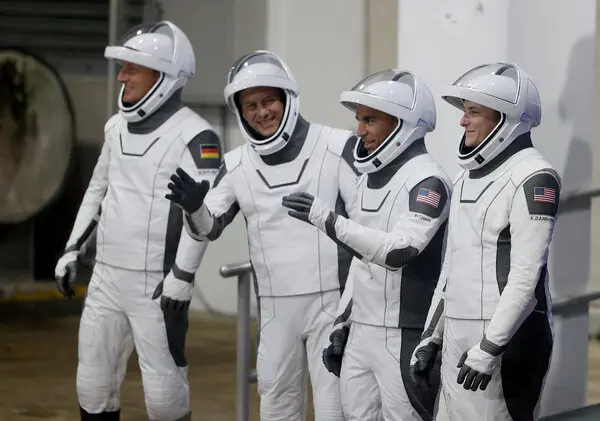

Turkey’s venture into crewed cosmic exploration has commenced on the country’s centennial anniversary, with Colonel Alper Gezeravci embarking on a two-week mission to the International Space Station (ISS) as part of the four-person crew of Axiom Mission 3.
Colonel Alper Gezeravci, a fighter pilot in the Turkish Air Force, marked a historic moment as he joined the ranks of astronauts from nations that have successfully sent individuals into space. The launch took place at 2149 GMT from the Kennedy Space Center in Florida, aboard a SpaceX Dragon capsule carried by a Falcon 9 rocket.
In an exclusive interview with TRT World before the launch, Colonel Gezeravci emphasized the symbolic significance of the mission, stating, “It’s a very symbolic, important step. However, it’s not the last. It’s the beginning of a journey for our great country.”
The mission, initially scheduled for Wednesday, was postponed for pre-launch checkouts and data analysis. The Ax-3 crew is expected to dock at the ISS on January 20 after approximately 36 hours of travel.
Turkish President Recep Tayyip Erdogan highlighted the mission’s importance for both scientific endeavors and inspiring the younger generation. Colonel Gezeravci’s launch into space aligns with Turkey’s National Space Program and is a crucial step toward the country’s goal of crewed space exploration.
Colonel Gezeravci’s first remarks in space reflected the visionary words of Turkey’s founding father, Mustafa Kemal Ataturk: “Istikbal goklerdedir!” (The future is in the skies).
The Ax-3 crew, led by Mission Commander Michael Lopez-Alegria, includes Colonel Walter Villadei from the Italian Air Force and Swedish astronaut Marcus Wandt from the European Space Agency. Once docked at the ISS, the crew will stay for 14 days, during which Colonel Gezeravci will conduct 13 scientific experiments prepared by Turkish scientists and research institutions.
Among the experiments is PRANET, created by middle school students from Turkey’s eastern city of Mus, which examines the antibacterial effects of propolis in microgravity environments. Other experiments cover materials science, biotechnology, electronic engineering, and cancer research, including the MYELOID experiment investigating the impact of radiation exposure on cancer cells in space.
Colonel Gezeravci expressed pride in representing Turkey on this historic occasion, stating that his mission will provide equal competition opportunities for Turkish scientists in various fields. The venture into space is not only a scientific achievement but also a source of inspiration for future generations.
The success of Turkey’s inaugural crewed space mission is a result of collaboration with international partners, including Axiom Space, SpaceX, and NASA. Colonel Gezeravci noted the unique experience gained from working with people from different countries and emphasized the strength of bringing together diverse backgrounds in the pursuit of scientific exploration.
As Turkey joins the ranks of nations capable of conducting successful crewed space missions, Colonel Gezeravci’s journey to the ISS symbolizes the country’s trajectory into a promising future in space exploration and scientific innovation, coinciding with the centennial anniversary of the Turkish Republic. The mission patch, adorned with symbols including a Seljuk star and the number 100, pays homage to Turkey’s rich heritage and the historic significance of the occasion.
