



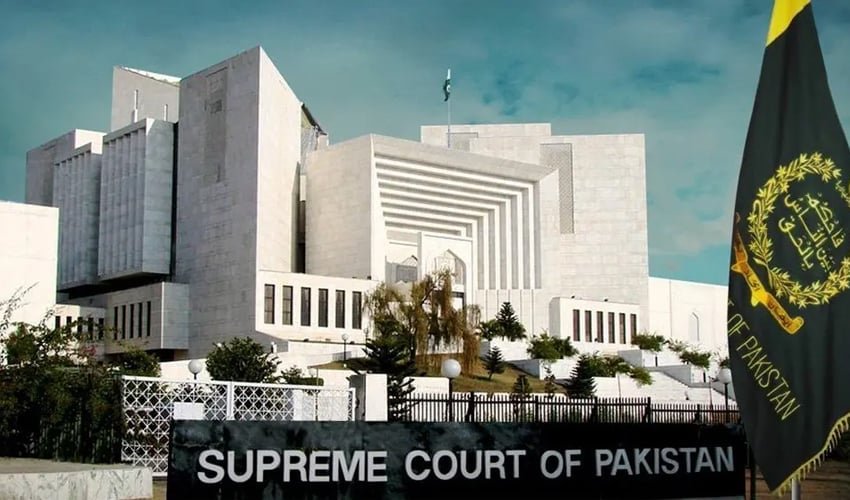
The Supreme Court has upheld its April 4, 2022 judgment, declaring the ruling of the then-deputy speaker on the no-confidence motion against ex-prime minister Imran Khan unconstitutional. A five-judge bench, headed by Justice Syed Mansoor Ali Shah, rejected the review petition jointly moved by former National Assembly speaker Asad Qaiser and deputy speaker Qasim Khan Suri.
During the hearing, senior counsel Naeem Bukhari argued on behalf of the petitioners, stating that the Supreme Court judgment did not adequately address the jurisdictional bar outlined in Article 69(2) of the Constitution. This clause prohibits courts from inquiring into parliamentary proceedings, and no officer or member of parliament shall be subject to the jurisdiction of any court for exercising their powers.
However, the bench dismissed the plea, noting that the matter pertained to the deputy speaker’s ruling and not their conduct in the Lower House. Justice Jamal Khan Mandokhel remarked that the court could intervene in cases involving constitutional violations.
Bukhari further argued that the apex court overlooked the point of order raised by the then law minister during the National Assembly session on April 3, 2022, related to the house’s business. He cited Rules 37(4) and 37(8) of the Rules of Procedure and Conduct of Business in the National Assembly, 2007, along with Article 69(2) of the Constitution, stating that the decision on a point of order is final and immune from judicial scrutiny.
The review petition was filed after the Supreme Court set aside the dissolution of the National Assembly by President Dr. Arif Alvi and directed then prime minister Imran Khan to face the no-trust motion. The petition contended that the fundamental right of freedom of association in Article 17(2) cannot be abridged by any law, but this doesn’t apply to the Constitution itself, which enables the suspension of fundamental rights by Article 233.
The court’s April 8, 2022 judgment considered Article 17(2) to override Article 69, which was deemed “difficult to comprehend.” The parliamentary form of government was highlighted as a salient feature of the Constitution, emphasizing that the decision or ruling of the speaker or deputy speaker on a point of order is final.
The detailed judgment was criticized for “importing” Articles 4 and 25 into the internal functioning of the National Assembly, invalidating the Rules of Procedure by giving precedence to Article 95 over Article 69. It concluded that the absence of discussion on the point of order and the decision repudiated the rule of law.
The point of order in question was raised by the information minister Fawad Chaudhry, who asserted that loyalty to the state was the basic duty of every citizen under Article 5(1). Alleging a foreign conspiracy behind the no-confidence motion, he called on the deputy speaker to decide the motion’s constitutionality. In response, Deputy Speaker Suri dismissed the resolution, ruling it as “contradictory” to the law, the Constitution, and the rules.
