

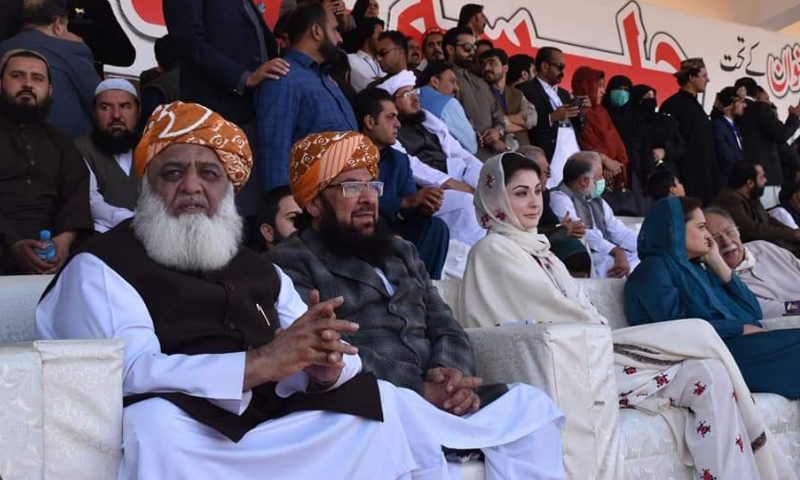

ISLAMABAD: Six political parties are joining the coalition governments in the center, Punjab and Sindh while other parties are yet to take a decision in this regard.
Political leaders from various parties, including the Pakistan Muslim League-Nawaz (PML-N), Pakistan People’s Party (PPP), Muttahida Qaumi Movement-Pakistan (MQM-P), Pakistan Muslim League, Istehkam-e-Pakistan Party (IPP), and Balochistan Awami Party (BAP), have unveiled plans to forge a coalition government.
This decision materialized subsequent to a gathering convened at Chaudhary Shujaat Hussain’s residence, where leaders deliberated on governance strategies.
Addressing the media post-meeting, Asif Ali Zardari voiced resolute intent towards establishing the coalition government. He underscored the need for a cohesive agenda, centering on economic, defense, and other pivotal concerns to fortify Pakistan’s trajectory.
Zardari emphasized that despite electoral competition, they aren’t ideological adversaries and possess the capacity to collectively steer the nation, extending the olive branch to include PTI in reconciliation efforts.
“Gratitude to Chaudhary Shujaat for hosting us,” Shahbaz Sharif conveyed appreciation for the gathering. “Elections have culminated, and Parliament’s formation looms ahead,” he remarked, stressing the transition. “Economic stabilization is imperative,” he asserted, accentuating financial resilience’s importance.
“National unity is indispensable for advancement,” Sharif remarked, underlining solidarity’s necessity amidst diverse factions. “The recent IMF accord has bolstered our economic stature,” he noted, recognizing international support’s pivotal role.
“Appreciation to Bilawal Bhutto for his voting stance,” Sharif acknowledged Bhutto’s decision. “The electorate has spoken; these parties now command a significant two-thirds majority,” he declared, highlighting the substantial electoral mandate.
“Inclusive representation from Sindh, Punjab, Balochistan, and KP underscores our collective vigor,” Sharif observed, stressing diverse yet united representation. “With our majority, we vow to confront the nation’s challenges,” he pledged, committing to effective governance.
“Did we not rescue Pakistan from the brink of insolvency?” Sharif queried, spotlighting past achievements and future aspirations.
Despite prior rivalries, MQM’s Khalid Maqbool Siddiqui stressed, “While our ideologies may differ, Pakistan’s welfare reigns supreme. We’ve previously supported Prime Minister Shehbaz Sharif and stand united once again.”
This sentiment resonates across the coalition, prioritizing national progress over individual party agendas.
Sadiq Sanjrani, representing the BAP, voiced optimism, stating, “Today heralds a fresh dawn. Together, we shall strive for a brighter future for all Pakistanis.” This collaborative ethos pervades the coalition, hinting at a potential shift towards more harmonized governance.
Conversely, Abdul Aleem Khan of the Istehkam-e-Pakistan Party (IPP) remains cautiously optimistic, amidst an overall atmosphere of hope and determination. “The populace grapples with inflation,” he acknowledged, “yet by setting aside personal agendas, we can forge solutions.”
