

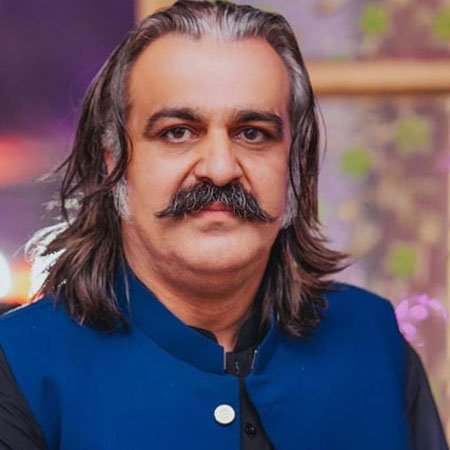

ISLAMABAD: On Monday, Ali Amin Gandapur, the designated Chief Minister of Khyber Pakhtunkhwa, took preemptive legal action by filing a transit bail application in the Peshawar High Court (PHC) amidst concerns of a potential arrest.
Gandapur’s legal team submitted the application, emphasizing his intent to personally appear in court and urged an expedited hearing, aiming for a resolution on the same day.
Addressing media representatives outside the PHC, Gandapur reiterated his commitment to not depending on federal government assistance, emphasizing his determination to tackle economic challenges and facilitate youth employment and business development opportunities.
Furthermore, he highlighted the party’s consultative approach to decision-making, indicating that the ultimate determination would be made by PTI’s founder.
Prior to this, the Election Commission of Pakistan (ECP) had issued a notification confirming the victory of Ali Amin Gandapur, a leader of the Pakistan Tehreek-e-Insaf (PTI), in both the national and provincial constituencies of Dera Ismail Khan during the general election held on February 8.
Gandapur secured wins in the National Assembly seat NA-44 and the provincial assembly constituency PK-113, significantly bolstering PTI’s position in Dera Ismail Khan. The ECP notification formalizes his success as an independent candidate in both electoral districts.
Meanwhile, Maulana Fazlur Rehman, the leader of the JUI-F, clarified that there is no formal alliance between his party and its longstanding rival, the Pakistan Tehreek-e-Insaf (PTI).
In an interview, Fazl remarked that interactions with PTI representatives have occurred previously, and his party has consistently treated them with respect.
The context of the question arose from a recent meeting between a PTI delegation and Fazl’s JUI-F, where they discussed concerns over the alleged rigging in the February 8 elections, foreseeing potential instability.
The PTI delegation, led by Asad Qaiser and including Barrister Saif, Amir Dogar, and Fazal Khan, engaged in dialogue with JUI-F leadership.
Fazl clarified that while discussions between political entities are customary, labeling such interactions as an “alliance” misconstrues the cultural norms, particularly in Pashtun traditions, where hospitality towards guests is paramount, and dialogue is always encouraged.
Expressing reservations about the election outcomes, especially in Khyber Pakhtunkhwa, Fazl emphasized the significant differences between the two parties, likening them to mountains that are not easily surmounted.
