

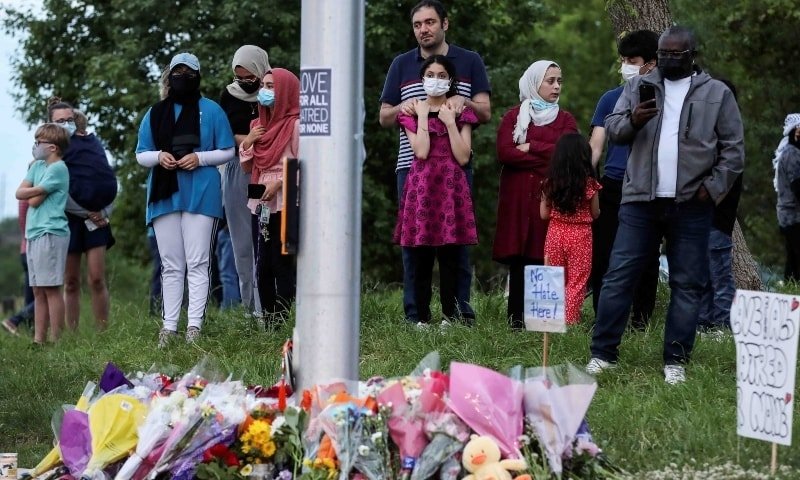

A self-professed Canadian white nationalist, Nathaniel Veltman, who intentionally struck and killed four members of a Pakistani-origin Muslim family with his pickup truck in 2021, received a life sentence on Thursday, without the possibility of parole for 25 years. Veltman, 23, had been convicted of first-degree murder in November for the shocking attack in London, Ontario, showing minimal reaction to the sentencing.
The judge, in a groundbreaking decision, characterized Veltman’s actions as an act of terrorism, marking the first instance of associating the term with white nationalist violence. The tragedy occurred when Veltman targeted the Afzaal family during their evening walk in June 2021, resulting in the deaths of Salman Afzaal, 46, his wife Madiha Salman, 44, their 15-year-old daughter Yumnah, and Salman’s 74-year-old mother Talat.
Tabinda Bukhari, Salman’s mother, expressed uncertainty about whether the verdict provided closure or justice but emphasized that it could not bring back what was lost. She highlighted the trial as a stark reminder of societal divisions. The incident stood out as the most severe assault on Canadian Muslims since the 2017 Quebec City mosque shooting, where six individuals were killed.
Crown attorney Sarah Shaikh, involved in prosecuting the case, condemned Veltman’s crime as “uniquely abhorrent,” targeting Muslims as a whole. She stressed that such hatred and ideologically driven violence against an entire community should never be tolerated in a democratic society.
Veltman had pleaded not guilty to the murder charges, with his defense attributing his actions to mental challenges, arguing for a lesser charge of manslaughter. However, Justice Renee Pomerance, presiding over the case, disagreed, categorizing Veltman’s actions as terrorist activity.
Prosecutors pointed out that Veltman had authored a manifesto titled “A White Awakening,” outlining his hatred of Islam and opposition to mass immigration and multiculturalism. Defense lawyer Christopher Hicks acknowledged the inevitability of the terrorism determination, considering the circumstances of the case and the lengthy trial. While he mentioned the presence of elements for a possible appeal, he indicated the need to consult with Veltman first.
