
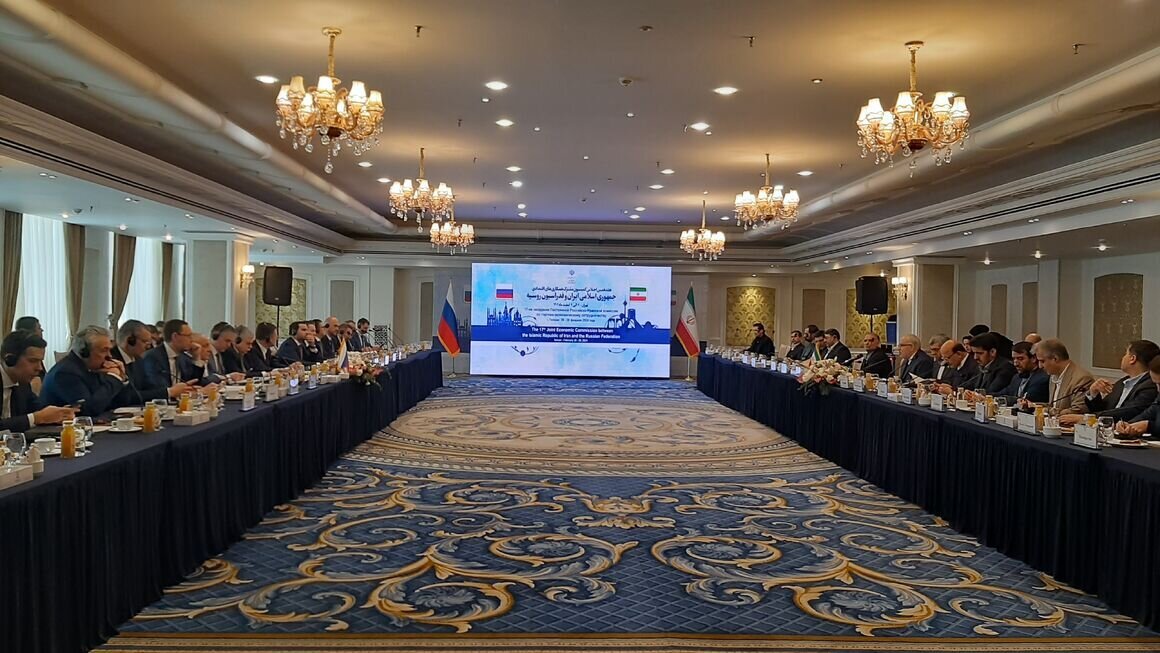

TEHRAN: Iran and Russia have inked multiple memorandums of understanding (MOUs) to bolster collaboration across diverse sectors, marking the conclusion of their 17th Joint Economic Committee meeting held in Tehran from February 26 to 28.
According to Shana, the MOUs were signed in the presence of Iranian Oil Minister Javad Oji and Russia’s Deputy Prime Minister Alexander Novak, who co-chaired the event. Over the course of three days, experts from both nations convened in 20 working groups to craft these MOUs and a comprehensive document outlining their cooperation.
In a sideline meeting during the Joint Economic Committee gathering, Iran’s Deputy Oil Minister for Engineering, Research, and Technology Affairs, Vahid-Reza Zeydifard, engaged with Transneft’s Deputy Head, Kalanda Vladimir Alexandrovich, exploring potential collaborations. Their discussions mainly centered on the application of smart tracking technologies for oil and gas pipelines.
Zeydifard highlighted the opportunity for collaboration between Iranian and Russian scientific and research centers, citing the Iranian Oil Industry Research Institute and Russian research institutes as potential partners.
He emphasized the importance of smart monitoring systems for pipelines given Iran’s expanding network, noting the capabilities of Iranian knowledge-based companies in this domain.
Alexandrovich expressed his company’s commitment to supporting Iran’s oil industry projects, stressing the mutual benefits of collaboration between Transneft and Iran. He acknowledged Iran’s advancements in the oil and gas sector, underscoring the potential for fruitful cooperation.
Furthermore, the Managing Director of Iran Khodro Company (IKCO) expressed readiness for collaboration with Russian automakers during discussions with the Head of Russia’s Federal Agency for Technical Regulations and Metrology (Rosstandart), Anton Shalaev.
IKCO aims to align its standards with those of Russia and has plans to export vehicles to the Russian market, starting with the Tara model.
Both sides emphasized the importance of cooperation for standard development in the automobile industry.
Additionally, Iran and Russia have agreed to establish new air routes and joint ventures in the transportation sector. Iranian Deputy Transport Minister Kamal Hadian-Far announced plans to finalize the Rasht-Astara railway project.
Iran’s Ambassador to Moscow, Kazem Jalali, highlighted the potential for gas cooperation between the two countries, emphasizing their global positions in terms of gas reserves and production.
Despite initial skepticism, economic cooperation has flourished, with significant investments from Russia, particularly in Iran’s oil industry.
Jalali emphasized that overcoming barriers such as cognition, transit, logistics, monetary and banking, and customs issues would further enhance bilateral relations.
He underscored the potential for Iran and Russia to collaborate on gas exports, emphasizing the breadth of opportunities beyond the energy sector.
