

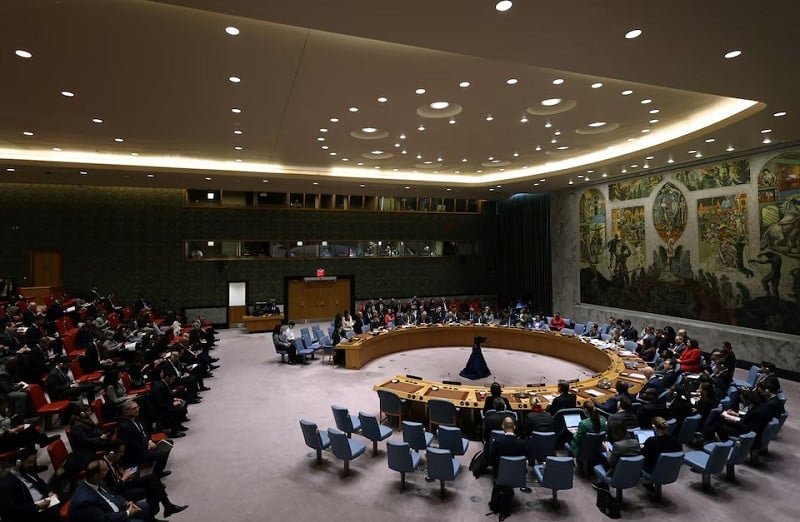

On Friday, the United Nations Security Council encountered a deadlock in passing a resolution urging an immediate ceasefire in Gaza as part of a hostage negotiation, with Russia and China vetoing the proposal put forth by the United States.
The resolution, which saw Guyana abstaining from voting, called for a prompt and sustained ceasefire lasting approximately six weeks to safeguard civilians and facilitate the delivery of humanitarian aid.
This signified a firmer stance from Washington towards Israel. Initially, the U.S. hesitated to endorse the term “ceasefire” and vetoed proposals advocating for an immediate cessation of hostilities earlier in the five-month-long conflict.
Linda Thomas-Greenfield, the U.S. Ambassador to the United Nations, expressed disappointment at the Security Council’s failure to adopt the resolution, emphasizing the majority support it garnered. She termed Russia and China’s veto as regrettable.
Before the vote, Thomas-Greenfield underscored the significance of adopting the resolution, considering it a “historic mistake” if neglected.
Russian Ambassador to the UN, Vassily Nebenzia, urged members not to support the resolution, labeling it as excessively politicized and potentially enabling Israeli military action in Rafah, a city in the Gaza Strip.
He warned that such action could lead to dire consequences for Gaza’s population.
China’s Ambassador to the UN also voiced support for an alternative resolution proposed by non-permanent members of the Security Council, emphasizing its balance. However, Thomas-Greenfield criticized this alternative, stating it lacked sensitivity to regional diplomacy and could provide an excuse for Hamas to reject ongoing negotiations.
U.S. Secretary of State Antony Blinken expressed optimism about ongoing talks in Qatar aimed at securing a six-week truce and the release of hostages.
A new resolution drafted by the 10 elected members of the Security Council, coordinated by Mozambique, could be presented for a vote soon. This resolution calls for an immediate ceasefire during the Muslim holy month of Ramadan, the release of hostages, and increased humanitarian aid to Gaza.
China’s ambassador criticized the U.S. draft for its perceived bias and failure to explicitly oppose Israeli military operations in Rafah. He argued that such conditions for a ceasefire were unacceptable, especially considering previous U.S. vetoes of similar resolutions.
Throughout the conflict, the U.S. has insisted on tying Security Council support for a ceasefire to the release of hostages held by Hamas. The U.S. has previously vetoed three resolutions, citing concerns that they might undermine ceasefire negotiations.
While traditionally supportive of Israel at the U.N., the U.S. has also abstained from votes, allowing the adoption of resolutions aimed at increasing aid and calling for temporary ceasefires.
