

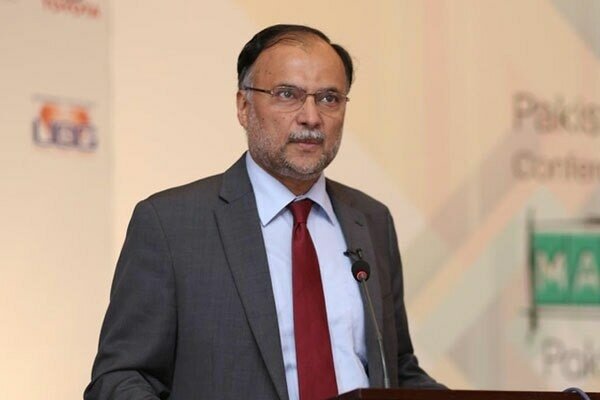

Federal Minister for Planning, Development, and Special Initiatives, Ahsan Iqbal, announced a major push for Balochistan’s development, unveiling a Rs230 billion allocation in the federal budget 2025–26. The initiative aims to accelerate the province’s growth through targeted infrastructure investments, as part of the government’s broader national development strategy.
Speaking at a press briefing, Iqbal emphasized that Balochistan’s progress is being treated as a national duty, following the directives of Prime Minister Shehbaz Sharif. The government plans to transform the province’s socio-economic landscape within two years by improving regional connectivity. A key focus is the N-25 Chaman-Quetta-Karachi highway, for which Rs100 billion has been earmarked. Other projects include work on the M8 and various regional road networks.
On water security, Iqbal warned of India’s potential to disrupt water flow under geopolitical pretexts. He said Pakistan is fast-tracking construction of the Diamer Bhasha and Mohmand dams, which together will add 7 million acre-feet of storage capacity.
Despite budgetary constraints—development spending has dropped from 2.6% of GDP in 2017–18 to just 0.8%—the government remains committed to public sector development. It plans to boost tax revenues and raise the tax-to-GDP ratio to 16% to ensure financial self-reliance.
The minister called recent economic improvements a “miracle turnaround,” citing inflation falling to 4%, interest rate cuts from 23% to 11%, and a resurgent stock market. FBR revenue collection jumped by 29%, while remittances rose from $27 billion to $37 billion.
Under the URAAN Pakistan plan, the government projects GDP growth to rise from 2.7% to 4.2% in FY2025–26. Infrastructure development will be fast-tracked, including the Peshawar–Torkham Expressway, Indus Highway, CPEC routes, and the Sukkur–Hyderabad Motorway. Work will also begin on the Karakoram Highway segment within the Diamer Bhasha Dam area.
In technology, over 200,000 students have received IT training under a national digital skills initiative. Future projects include “Silicon Valley Pakistan” and multiple national centers for quantum computing, nanotechnology, robotics, and advanced manufacturing.
For health, Rs64 billion is allocated, with a major goal to eliminate Hepatitis C by 2030. Key educational and medical projects include the Jinnah Medical Complex and the Danish University, envisioned as a hub for global-class research and innovation.
