

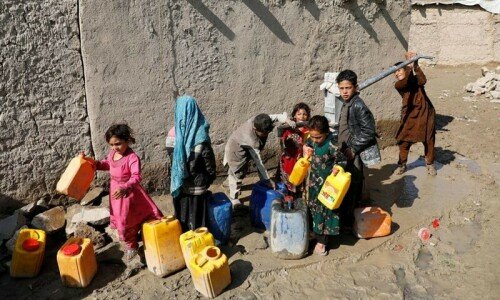

The head of the World Food Programme (WFP) in Afghanistan has warned that the agency is only able to provide food for half of the millions of Afghans in need, due to significant cuts in international aid and a looming freeze on US foreign funding.
Many people in Afghanistan are now surviving on little more than “bread and tea,” said Hsiao-Wei Lee, WFP’s Country Director in Afghanistan, in an interview.
The country faced an economic collapse in 2021 when the Taliban took control, resulting in the suspension of all development and security assistance, along with restrictions on the banking sector. Since then, humanitarian aid, designed to address urgent needs without going through the Taliban government, has helped fill some of the gap. However, donor funding has steadily decreased, partly due to the Taliban’s restrictions on women, including their order banning Afghan women from working in NGOs, and the pressures of global crises.
Just before finishing her three-year term in Afghanistan, Lee explained that funding cuts had meant that about half of the 15 million Afghans experiencing acute food insecurity were not receiving aid during this harsh winter. “That’s over 6 million people who are probably eating one or two meals a day, and it’s just bread and tea,” she said.
Afghanistan’s humanitarian plan for 2024 was funded at just over 50% of the required amount, according to UN data, and aid officials have raised concerns that funding could fall even further in the coming year.
Last Friday, the US State Department issued a “stop-work” order for all ongoing foreign assistance and paused new aid, following an order from President Donald Trump to review aid allocation in line with his foreign policy priorities. While the full impact on Afghanistan’s humanitarian operations remains unclear, in 2024, more than 40% of the aid to Afghanistan was provided by the US, the largest donor.
“I think any potential reduction in assistance for Afghanistan is concerning,” Lee said. “The levels of need are just so high here, and I certainly hope that any decisions made, and the implementation of those decisions, will take into consideration the needs of the people—especially women and children.”
Global emergencies, such as those in Sudan, Ukraine, and Gaza, alongside concerns about the Taliban’s restrictions on women, have led to a decline in aid to Afghanistan. Additionally, the International Criminal Court prosecutor recently applied for arrest warrants for two senior Taliban leaders, including supreme leader Haibatullah Akhundzada, accusing them of persecuting women and girls.
Lee described the operating environment as a “rollercoaster” over the past three years, but emphasized that the WFP has continued to deliver aid to women and children despite the challenges. Though the Taliban have banned female NGO workers from their jobs, many humanitarian organizations, including WFP, have been granted exemptions in certain sectors, particularly in health.
Despite the ongoing restrictions and funding shortfalls, Lee noted that WFP has managed to adapt and continue reaching female beneficiaries with vital assistance.
