

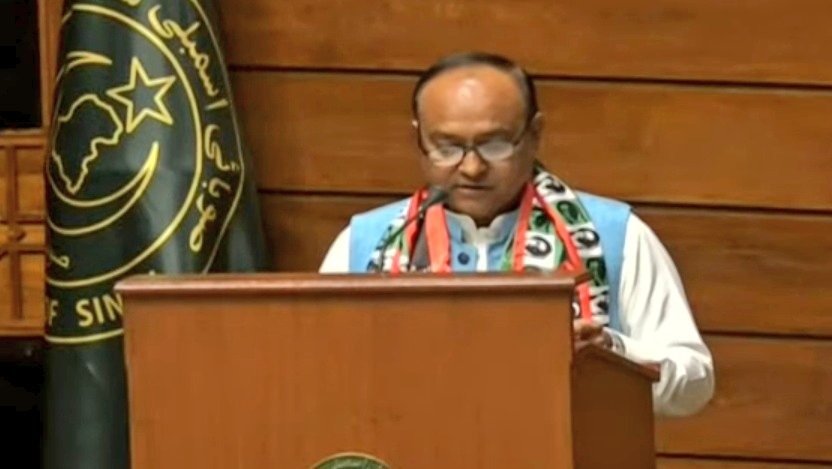

Anthony Naveed, the newly-elected deputy speaker of the Sindh Assembly, never envisioned or aspired to hold such a position. However, he now stands as the first minority member in the country to preside over the proceedings of a legislature.
Born into a modest Catholic family in Karachi’s Akhtar Colony, now 53-year-old Naveed grew up with his father, who worked in a private job, along with a brother and two sisters. He completed his education at St. Patrick’s School and later obtained an engineering diploma in garment technology from the Pakistan Swedish Institute of Technology.
From an early age, Naveed displayed an interest in community activities, eventually serving as the vice-president of the Christian Boys Association and collaborating with the Pakistan Christian Congress.
His political journey began in 2005 when the Pakistan Peoples Party offered him a ticket for Karachi’s local body election. Contesting as a vice-chairman from Akhtar Colony, he aligned with a Jamat-e-Islami candidate as chairman, marking a significant moment in bringing a member of the Christian community into Pakistan’s mainstream politics.
Subsequently, Naveed became a special assistant to Sindh’s chief minister in 2016, nurturing ambitions of becoming a legislator. Although he also aimed for a Senate seat, the party nominated him as a reserved seat candidate in the Sindh Assembly, where he served from 2018 to 2023 as the sole Christian member.
Throughout his tenure, Naveed advocated for minority rights, spearheading campaigns under the National Lobbying Delegation for Minority Rights in Pakistan to secure constitutional rights for minority groups, including quotas in education, employment, and Christian personal law.
In a recent interview, Naveed expressed that he never imagined becoming a deputy speaker, considering the limited scope for legislative action in that role. Nevertheless, he remains hopeful about effecting change regarding minority quotas in education and employment, as well as advocating for Christian personal law.
