

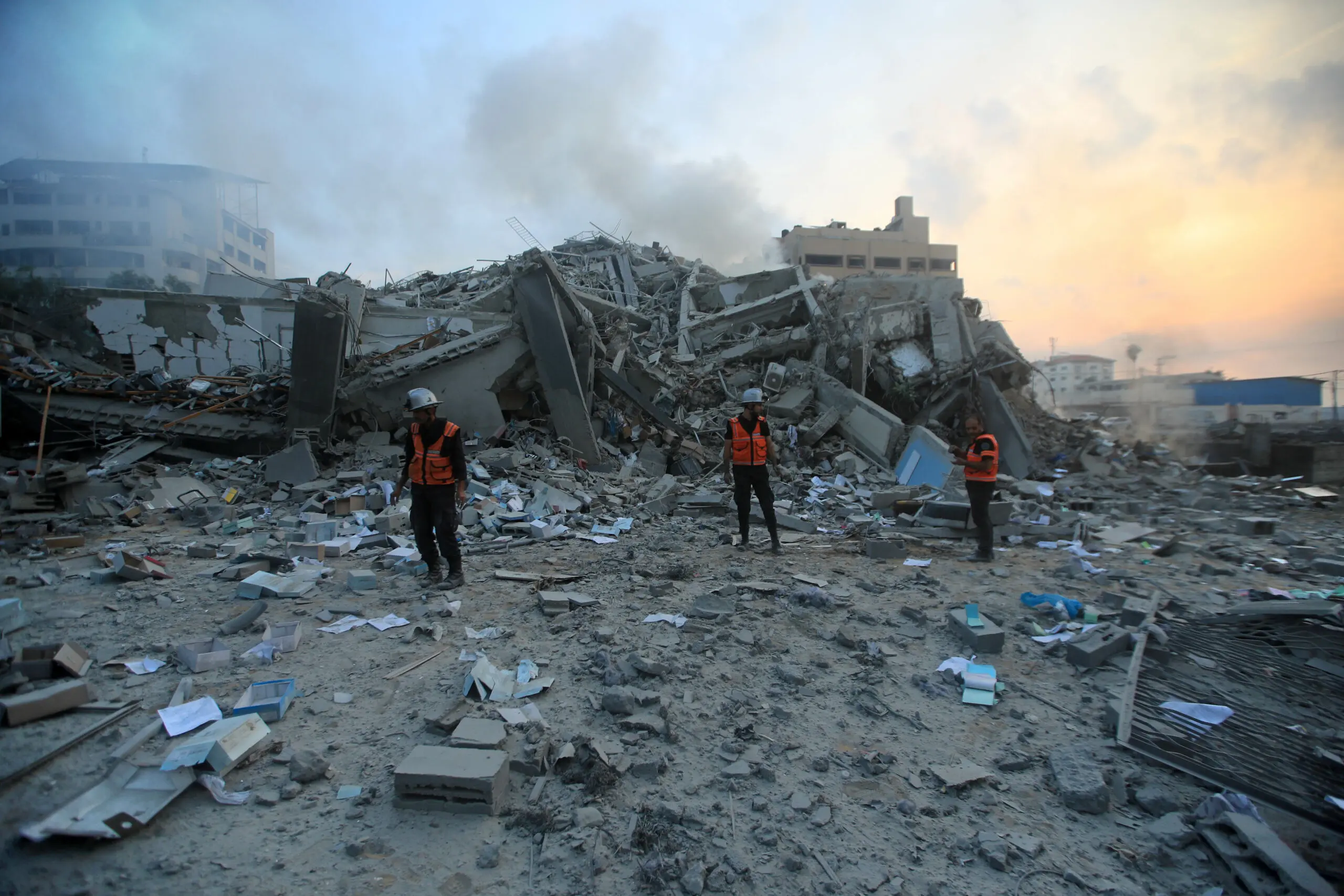

GAZA/CAIRO: At least 91 Palestinians were killed, and dozens more were wounded in airstrikes across Gaza on Thursday after Israel resumed bombing and ground operations, effectively ending a two-month ceasefire, according to Gaza’s Health Ministry.
After two months of relative calm, Gazans once again found themselves fleeing for their lives as Israel abandoned the ceasefire and launched a new air and ground assault against Hamas, the dominant Palestinian faction in the enclave.
Israeli aircraft dropped leaflets over residential neighborhoods, ordering evacuations from Beit Lahiya and Beit Hanoun in the north, the Shejaia district in Gaza City, and towns on the eastern outskirts of Khan Younis in the south.
By late Thursday, Israel’s military announced the initiation of ground operations in the Shaboura district of Rafah, Gaza’s southernmost city, near the Egyptian border.
“War is back, displacement and death are back, will we survive this round?” said Samed Sami, 29, who fled Shejaia and set up a tent for his family in a makeshift camp.
A day after sending tanks into central Gaza, Israel’s military confirmed on Thursday that ground operations had also begun in Beit Lahiya, located along Gaza’s northern coastal route.
Hamas, which had not retaliated during the first 48 hours of the renewed Israeli assault, reported launching rockets into Israel. Israeli authorities confirmed that sirens had sounded in central Israel following the rocket fire.
Some Gazans reported no visible signs of Hamas preparing to intensify fighting. However, a source from a group allied with Hamas, who wished to remain anonymous, told Reuters that fighters had been put on alert, awaiting further instructions, and were instructed to avoid using mobile phones.
After talks to extend the ceasefire failed, Israel resumed its airstrikes on Gaza with a massive bombing campaign on Tuesday, followed by the deployment of ground troops the next day.
HUNDREDS DEAD
Tuesday’s first day of resumed airstrikes resulted in the deaths of over 400 Palestinians, one of the deadliest days of the 17-month-long conflict. The bombing campaign has shown little sign of easing since then.
This week’s strikes have also targeted high-ranking Hamas officials, killing some of the group’s key figures, including the head of Gaza’s Hamas-appointed government, the chief of security services, his aide, and the deputy head of Hamas’ justice ministry.
Hamas has condemned the Israeli ground operation and the incursion into the Netzarim corridor, calling it a “new and dangerous violation” of the ceasefire agreement. The group reaffirmed its commitment to the truce and urged mediators to take action.
A Complicated Return to Full War
For Israel, the return to full-scale conflict could be fraught with challenges, according to current and former officials, citing waning public support and burnout among military reservists. Protests have also emerged, accusing Prime Minister Netanyahu of continuing the war for political reasons and putting the lives of remaining hostages at risk.
The initial phase of the ceasefire ended earlier this month. Hamas has demanded that Israel engage in negotiations to end the war, withdraw its troops from Gaza, and facilitate the exchange of Israeli hostages for Palestinian prisoners.
Israel has proposed only a temporary extension of the truce, cut off all supplies to Gaza, and resumed military operations aimed at pressuring Hamas to free the remaining hostages.
On Thursday, the Israeli military intercepted two missiles fired from Yemen towards Israel, one in the early morning and another in the evening. No casualties were reported. Yemen’s Iran-aligned Houthi forces have periodically fired missiles at Israel in support of Gaza’s Palestinians.
‘WE DON’T WANT DEATH’
The ceasefire had allowed Huda Junaid, her husband, and family to return to their destroyed home site to camp out among the ruins. But now, they’ve been forced to flee again, packing their few remaining belongings onto a donkey cart and searching for a new place to set up a tent near a school.
“We don’t want war, we don’t want death. Enough, we are fed up. There are no longer children in Gaza, all of our children are dead, all of our relatives are dead,” she said.
A Hamas official told Reuters on Thursday that mediators had increased efforts to reach a breakthrough, but no progress had been made.
The war began after Hamas attacked Israeli communities near the Gaza border in October 2023, killing 1,200 people and taking over 250 hostages, according to Israeli authorities.
More than 49,000 Palestinians have been killed in the ongoing conflict, according to Gaza’s health authorities, with much of the enclave reduced to rubble.
