

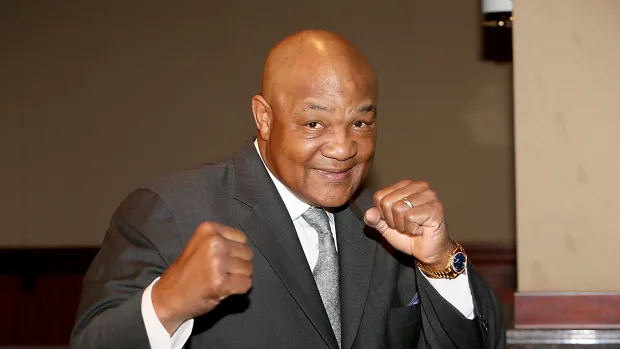

George Foreman, the former heavyweight champion known for his legendary bout against Muhammad Ali in the 1974 “Rumble in the Jungle,” has passed away at the age of 76, his family confirmed.
“With deep sorrow, we announce the passing of our beloved George Edward Foreman Sr., who peacefully left us on March 21, 2025, surrounded by his loved ones,” the family stated on the boxer’s official Instagram page. “We appreciate the overwhelming support and prayers and kindly request privacy as we honor his remarkable life.”
Born in Texas on January 10, 1949, Foreman was raised in Houston. He discovered later in life that J.D. Foreman, the man who raised him, was not his biological father. His real father, a decorated World War II veteran, contacted him only after he won the world heavyweight title.
During his youth, Foreman struggled with crime and dropped out of school at 16. “At 13, George was already 6-foot-2, weighed 200 pounds, and was feared in the neighborhood,” his younger brother Roy recalled in 2024. “When you’re bigger and stronger, you tend to take what you want.” It was at 16 that Foreman turned to boxing.
“I wanted to be a football player,” Foreman once wrote on his website. “I tried boxing just to prove to my friends I wasn’t scared. A year and 25 fights later, I was an Olympic gold medalist.”
At the 1968 Mexico Olympics, the 19-year-old Foreman dominated the competition, securing the super-heavyweight gold medal. As he celebrated, he waved an American flag in the ring, just days after fellow Black athletes Tommie Smith and John Carlos had made a Black Power salute during the 200m medal ceremony.
Standing at 6-foot-4 (1.93m), ‘Big George’ was larger and stronger than many of his heavyweight rivals. He was agile but relied heavily on brute force, quickly rising through the professional ranks. His defining moment came in 1973 when he challenged heavyweight champion Joe Frazier, knocking him out in just two rounds to claim the title.
By October 1974, Foreman was an undefeated champion with 40 victories, most by knockout. However, his historic fight against Muhammad Ali in Kinshasa exposed his weaknesses. Ali’s ‘rope-a-dope’ strategy exhausted Foreman, leading to an eighth-round knockout loss. The defeat shattered Foreman’s confidence.
“I couldn’t believe I had lost the world title,” he later admitted. “It was the most embarrassing moment of my life. I went from pride to pity. That was devastating.”
Foreman’s attempt at a comeback ended in 1977 after losing a decision to Jimmy Young in Puerto Rico. Following the bout, he experienced a life-changing moment and claimed he felt God calling him to a different path. He retired at 28 and became an ordained minister.
A decade later, Foreman announced an unlikely return to the ring. He had transformed physically—bald, heavier, and seemingly past his prime—but he insisted the comeback was to fund his youth center. Over three years, he won 21 consecutive fights, mostly against lesser opponents.
His resurgence earned him title fights against Evander Holyfield in 1991 and Tommy Morrison in 1993, both of which he lost on points. Then, in November 1994, he faced Michael Moorer, the reigning heavyweight champion. Trailing on the scorecards, Foreman delivered a stunning knockout punch in the 10th round, reclaiming the world title at 45 years old, making him the oldest heavyweight champion in history.
Although he was later stripped of his WBA and IBF titles for refusing mandatory challengers, Foreman remained an active fighter until 1997. His final bout, at age 48, was a points loss to Shannon Briggs. He retired with a professional record of 81 fights, 76 wins, and 68 knockouts.
Outside the ring, Foreman gained fame as a businessman and television personality. In 1994, he endorsed the “George Foreman Lean Mean Fat-Reducing Grilling Machine,” a product that became a global success.
Foreman, who also hosted a TV show on fatherhood in 1996, was married four times and had 12 children, including five sons—all named George Edward Foreman. Explaining this decision, he once said, “I wanted them to understand that if one of us rises, we all rise together, and if one falls, we all fall together.”
