

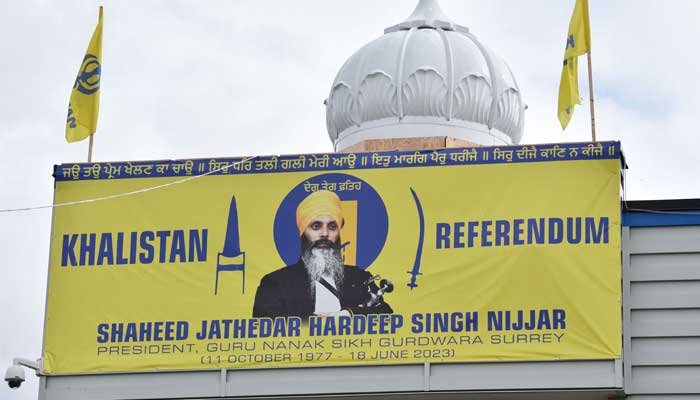

Sources Reveal Canadian Police Have Evidence Linking Indian Diplomats to Sikh Leader’s Murder Plot. Canada has officially expelled India’s High Commissioner Sanjay Kumar Verma and five other diplomats amid escalating tensions over the assassination of Sikh leader Hardeep Singh Nijjar. This decision comes as the Canadian national police prepare to disclose new details about the Indian government’s alleged involvement in “violent criminal activity” targeting pro-Khalistan separatists in Canada.
Following the expulsion notification, India quickly recalled the six diplomats. Canadian sources indicate that police and intelligence have concrete evidence implicating the Indian diplomats in the June 2023 murder plot against Nijjar, who was closely associated with Sikhs for Justice (SFJ) founder Gurpatwant Singh Pannun, himself a target of multiple assassination attempts.
The Canadian government presented this evidence to India last week, informing Prime Minister Narendra Modi’s administration about the involvement of its senior diplomats in assassination schemes.
A senior Canadian official stated that Canada possesses information suggesting Indian agents are linked to other violent incidents in the country. Following Nijjar’s killing, numerous Sikhs advocating for the Khalistan Referendum have reportedly received warnings about credible threats to their safety.
RCMP Commissioner Mike Duheme is set to reveal further details at a press conference in Ottawa.
In response to the investigation, the Indian government announced the preemptive withdrawal of its High Commissioner and other diplomats after being informed that they were considered “persons of interest.” New Delhi vehemently rejected these allegations, labeling them as politically motivated accusations from the Trudeau government.
Shortly after Canada expelled the Indian diplomats, India announced it would expel six Canadian diplomats, including Acting High Commissioner Stewart Ross Wheeler. They have been given until 11:59 PM on October 19, 2024, to leave India.
Tensions between India and Canada have been mounting since September 2023 when Prime Minister Trudeau asserted that there was credible evidence linking Indian agents to Nijjar’s assassination on Canadian soil. On Monday, India’s Ministry of External Affairs summoned the Canadian chargé d’affaires to protest against what it described as “completely unacceptable” and “baseless targeting” of its diplomats.
The relationship between the two nations further deteriorated in October 2023 when Canada withdrew over 40 diplomats from India following a request from New Delhi to reduce its diplomatic presence.
Earlier this year, a committee of Canadian parliamentarians identified India as a significant foreign threat to its democratic institutions based on intelligence agency input. Moreover, following Canada’s allegations regarding Nijjar’s killing, the U.S. also claimed Indian agents were involved in a failed assassination attempt on SFJ leader Pannun in New York.
In a strong statement following the expulsions, SFJ General Counsel Gurpatwant Singh Pannun highlighted the significance of Canada’s actions, asserting that it reflects the Indian diplomats’ involvement in logistics and intelligence for Nijjar’s assassination and underscores the existence of a spy network targeting pro-Khalistan Sikhs in Canada.
Sikhs for Justice has been actively pushing for investigations into the roles of Indian diplomats in Nijjar’s murder, allocating a budget of $500,000 to track the movements of Verma and hold him accountable.
Pannun emphasized that the expulsion of Sanjay Verma demonstrates the Indian diplomat’s role in escalating criminal activities that threaten the safety of pro-Khalistan Sikhs in Canada. He cited instances of hate speech against peaceful Khalistan activists by pro-Indian Canadian politicians as further evidence of the hostile environment created by Indian diplomatic missions.
