


China has vowed to take “all necessary countermeasures” in response to US President Donald Trump’s announcement of a new 10% tariff on Chinese imports, set to go into effect on Tuesday. This latest move, along with a 25% tariff on imports from Canada and Mexico, will escalate the trade tensions between the world’s two largest economies.
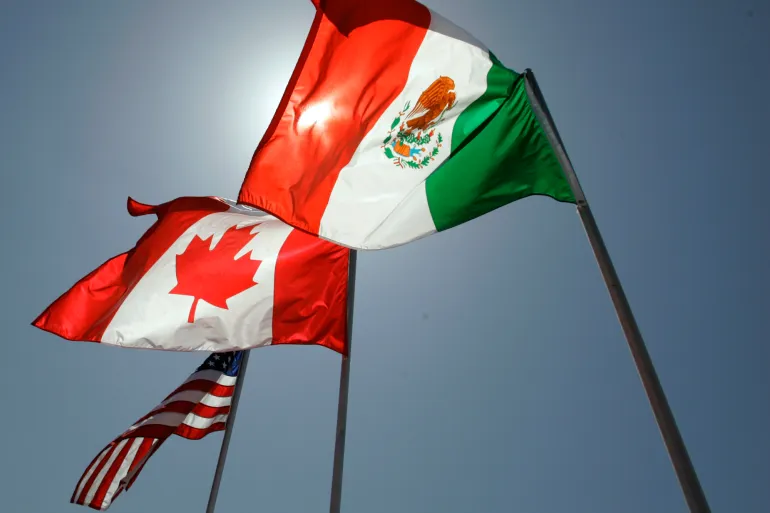
The 10% tariff on Chinese goods will be added to the existing levy of the same rate imposed earlier this month by Trump. The tariffs on Canada and Mexico, aimed at addressing illegal immigration and the fentanyl crisis, were initially announced but postponed. However, the suspension is set to end on March 4.
Global markets reacted negatively on Friday, reflecting growing concerns that the escalating trade dispute could have far-reaching economic impacts. Trump had previously announced, and then paused, the 25% tariffs on Canadian and Mexican imports, with the energy sector from Canada receiving a lower rate. Now, those levies will take effect next week as planned.
Trump defended his decision on social media, stating that the tariffs will remain unless significant progress is made on curbing the flow of fentanyl into the United States. “Until the problem of fentanyl is stopped, or is seriously limited, the tariffs will happen as scheduled,” Trump wrote.
In response to Trump’s allegations that China is contributing to the fentanyl crisis, a Chinese commerce ministry spokesperson rejected the claim, accusing the US of “shifting the blame.” The spokesperson emphasized that China enforces some of the strictest anti-narcotics policies globally, which Washington has “ignored.”
The statement further warned that the new tariff hikes would not resolve the US’s internal issues but would instead “increase the burden on American businesses and consumers” and disrupt the global supply chain.
China’s leadership is expected to meet next week to formulate plans to protect its economy from the impact of Trump’s measures.
In Mexico, President Claudia Sheinbaum expressed hope for direct talks with Trump to avoid the tariffs, while a high-level Mexican delegation is currently in Washington seeking an agreement. Similarly, Canadian Prime Minister Justin Trudeau stated that officials are working urgently to prevent the imposition of tariffs but will respond “immediately” if the measures are implemented. Trudeau has repeatedly pointed out that less than 1% of fentanyl and illegal migrants entering the United States come through Canada.
Trump’s tariff threats have sparked widespread concern in major export countries, with Asian markets particularly affected. Tokyo stocks fell by 3% in early trading on Friday, reflecting the growing anxiety surrounding the trade conflict.
In addition to the fentanyl-related tariffs, Trump also reiterated on his Truth Social platform that “reciprocal tariffs” will take effect on April 2. These tariffs will be tailored to each US trading partner, with more details expected after relevant trade studies are completed.
In a letter to US Trade Representative Jamieson Greer, Chinese Commerce Minister Wang Wentao called for dialogue between the two countries to resolve their trade differences. China has consistently pushed back against the US’s focus on fentanyl, arguing that Washington should address the issue domestically rather than blaming other countries with tariffs.
A report from the Congressional Research Service noted that much of the fentanyl entering the US is made in Mexico using chemical precursors sourced from China. Some of these precursors are not subject to international controls, making it easier for them to be legally exported.
Earlier this year, China’s foreign ministry warned that new tariffs could undermine counter-narcotics cooperation between the two nations.
