

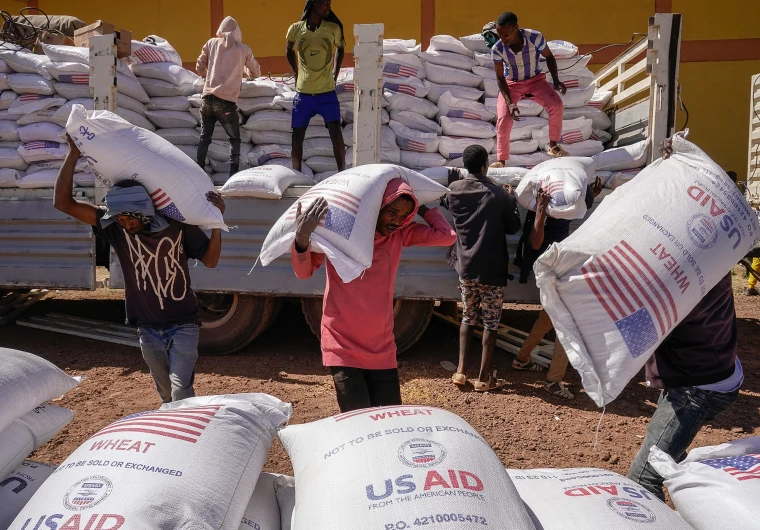

As the United States reduces its humanitarian aid to Southeast Asia, China may seize the opportunity to increase its influence in a region where it has already invested billions of dollars in aid and development projects, analysts suggest.
Since President Donald Trump’s inauguration, the U.S. has significantly cut back on foreign aid, including moving to eliminate the U.S. Agency for International Development (USAID), a key tool of American soft power. USAID, the largest distributor of U.S. foreign aid, allocated $860 million in Southeast Asia last year alone, supporting various initiatives ranging from HIV treatment to biodiversity conservation and local governance enhancement.
Many of these projects, primarily funded through grants to local NGOs, now face an uncertain future as the Trump administration pulls the U.S. back from international commitments as part of its “America First” agenda.
This shift in U.S. foreign policy presents China with an opening, according to Yanzhong Huang, a senior fellow for global health at the Council on Foreign Relations. “The suspension of key U.S. health, education, and humanitarian programs could create vacuums that China might fill,” Huang told Al Jazeera.
“This strategic retreat may enhance Beijing’s influence across the region, especially in countries that have traditionally received U.S. aid, like Indonesia, the Philippines, Myanmar, and Cambodia.”
While the Trump administration garnered attention for its cuts to USAID, China stepped in with a $4.4 million contribution to fund a de-mining project in Cambodia that was abandoned by Washington. Heng Ratana, head of the Cambodian Mine Action Centre, told the Khmer Times that the Chinese aid would help clear over 3,400 hectares (8,400 acres) of land contaminated by landmines and unexploded ordnance.
Despite this move, China’s embassies in the U.S., Cambodia, and Thailand did not respond to Al Jazeera’s requests for comment.
