

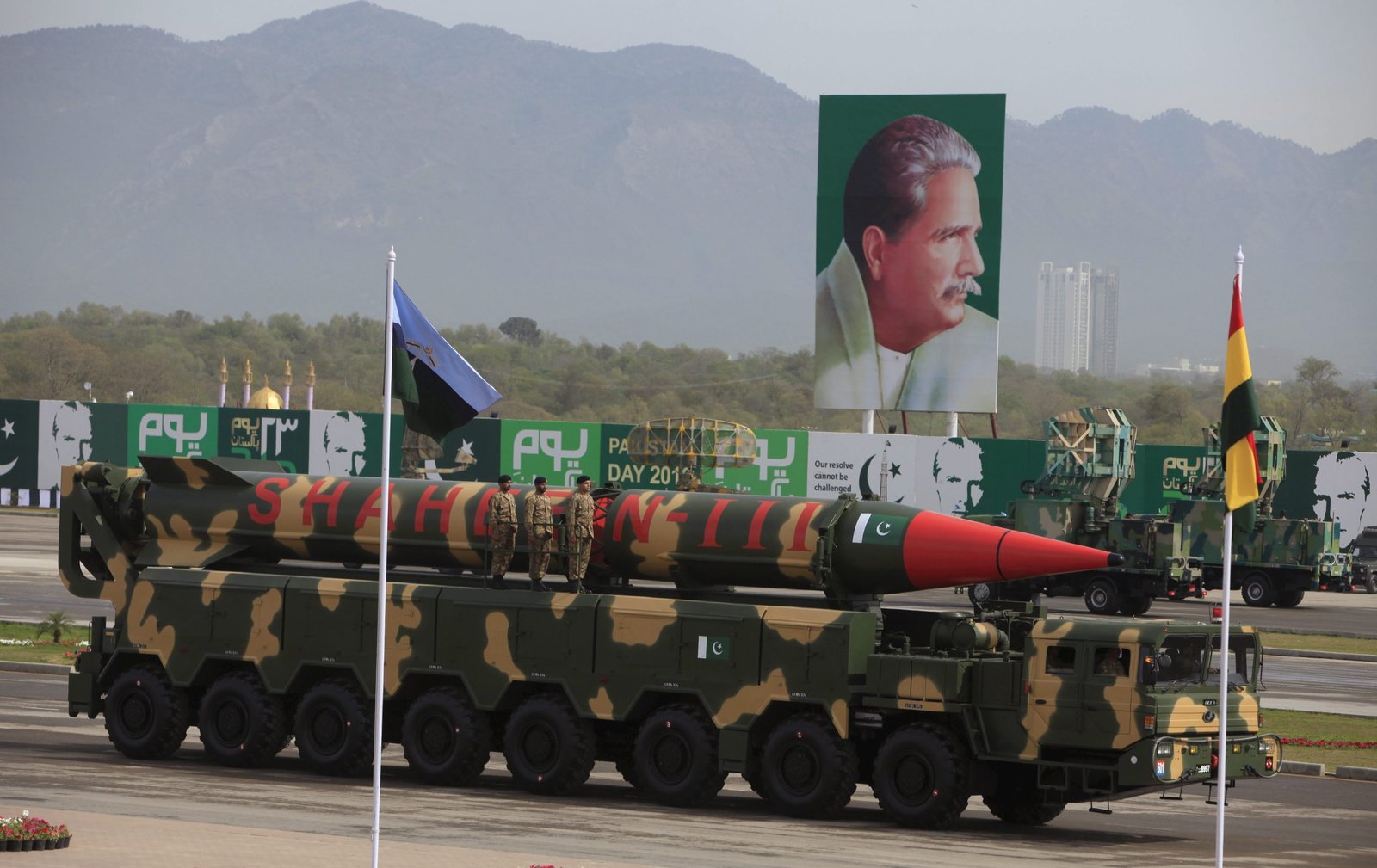

Top Nuclear Body
Amid escalating hostilities between India and Pakistan, the government of Pakistan announced on Saturday that it had convened a high-level meeting of the National Command Authority (NCA) — the body responsible for overseeing the country’s nuclear arsenal — following its retaliatory military operation against Indian targets.
The meeting, according to Prime Minister Shehbaz Sharif’s office, was called to assess the security situation and determine the strategic course ahead. However, Defence Minister Khawaja Asif contradicted this, saying no such meeting had yet taken place.
Tensions between the two nuclear-armed neighbours have surged dramatically since India reportedly launched missile strikes on three Pakistani airbases on the night of May 7, including one near the capital Islamabad.
Pakistan responded with a series of targeted military strikes under “Operation Bunyanun Marsoos”, which the military says took out key Indian military installations, including a BrahMos missile storage site in Beas, the Pathankot airfield in Indian Punjab, and Udhampur Air Force Station in Indian-occupied Kashmir.
Pakistan’s military spokesperson Lt Gen Ahmed Sharif Chaudhry stated that most of the Indian missiles were intercepted, and no major damage to air assets was reported. However, the strikes triggered loud explosions in cities including Lahore and Peshawar, while sirens were reported in Indian Illegally Occupied Jammu and Kashmir (IIOJK), where casualties were also reported.
The mounting military exchanges — involving missiles, drones, and shelling along the Line of Control — mark the worst confrontation between the two countries in three decades. At least 48 people have reportedly died since the violence began mid-week, though casualty numbers have not been independently verified.
Planning Minister Ahsan Iqbal emphasized that Pakistan’s military response was measured and aimed only at military installations that posed a threat to its security. “We are not targeting civilians,” he said, adding that Pakistan’s intention was to send a strong yet responsible message.
Meanwhile, India continues to claim that its air strikes were a response to a deadly attack on Hindu tourists in IIOJK last month, which it blames on groups operating from Pakistan — a charge Islamabad has strongly denied. The Indian Army reported that multiple Pakistani drones had entered its airspace and were subsequently shot down.
The situation has sparked international concern, with diplomatic pressure mounting to halt the escalation. US Secretary of State Marco Rubio held a phone call with Pakistan’s Army Chief General Asim Munir to stress the need for restraint and offered US assistance in facilitating dialogue between the two countries. Similarly, the G7 countries and the UK have urged both sides to exercise maximum restraint and resume diplomatic engagement.
Analysts have warned that the convening of the NCA signals a grave shift in the crisis, underscoring how close both nations may be to breaching critical thresholds. Asfandyar Mir, a senior fellow at the Stimson Centre, said the move acts as a “soft nuclear signal,” in line with Pakistan’s doctrine that does not rule out first use in the face of existential threats.
With military exchanges ongoing and diplomatic efforts intensifying, the region remains on edge, facing one of its most dangerous moments in recent history.
