

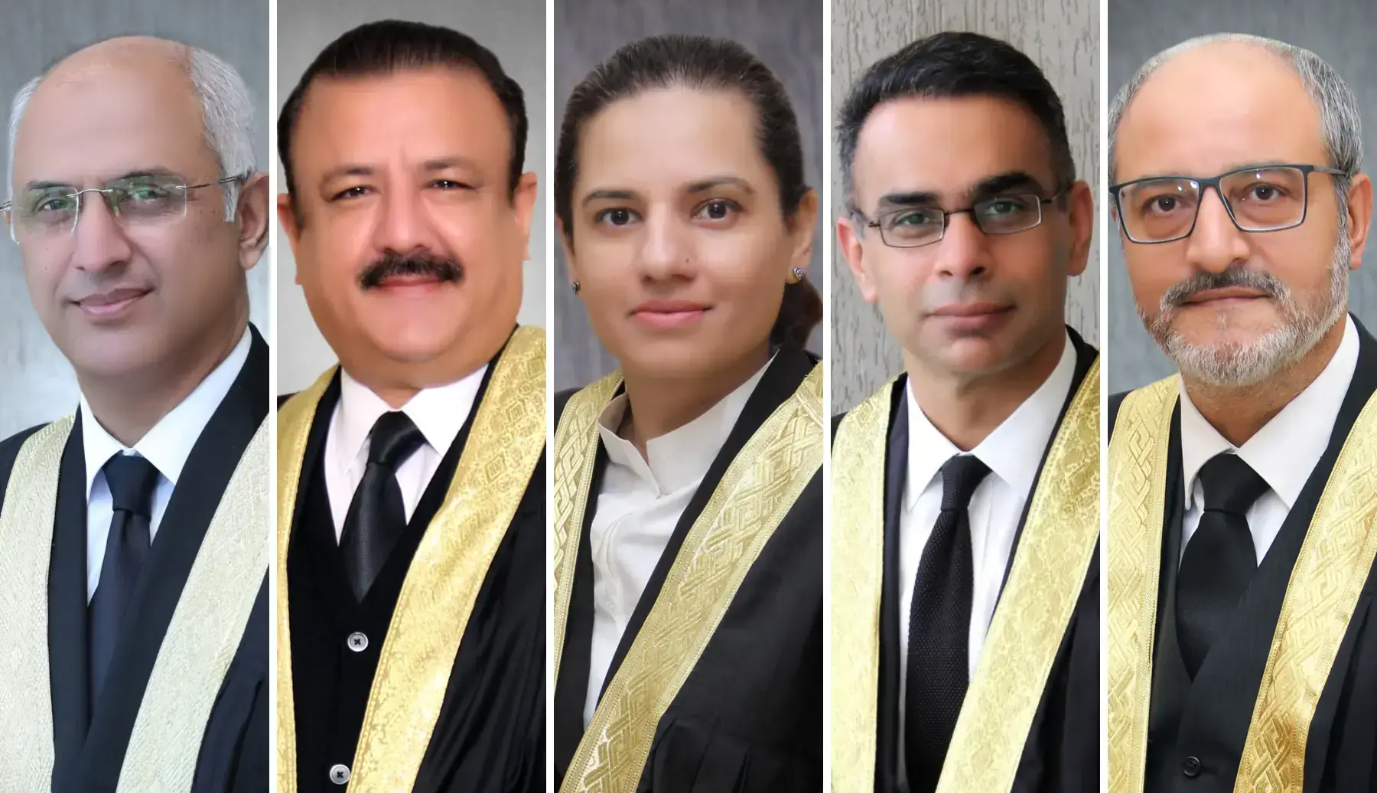

Five sitting judges of the Islamabad High Court (IHC) have formally challenged the scheduled hearing of their intra-court appeal (ICA) before the newly formed Federal Constitutional Court (FCC). The hearing is set for November 24 and follows the Supreme Court’s previous verdict upholding the legality of their transfer to the IHC.
The judges involved are Justice Mohsin Akhtar Kiyani, Justice Tariq Mehmood Jahangiri, Justice Babar Sattar, Justice Sardar Ejaz Ishaq Khan, and Justice Saman Riffat Imtiaz. They submitted an application questioning the FCC’s authority to hear their appeal, arguing that the case does not fall under Articles 175E or 175F of the Constitution.
Background of the Case
The intra-court appeal challenges a Supreme Court ruling confirming the legality of their transfer to the Islamabad High Court. The FCC, established under the 27th Amendment, is now set to hear the ICA. The five judges argue that this new court cannot lawfully adjudicate their appeal.
They contend that the transfer and the hearing framework under the 27th Amendment overreach statutory limits. The petition seeks to return the appeal to the Supreme Court for proper determination. The judges argue that the 27th Amendment neither amended the Supreme Court (Practice and Procedure) Act 2023 nor addressed appeals filed under Section 5 of the Act.
Constitutional Arguments Against FCC Jurisdiction
The petition asserts that Article 175F(2) permits only certain appeals to be transferred to the FCC. Since the current appeal was filed under Section 5 of the Supreme Court Act, it should remain with the Supreme Court. The judges submitted that the FCC lacks legal authority to hear this appeal, making the transfer invalid.
They further argued that a forum created by legislation cannot lawfully decide on the constitutionality of the law that created it. In this context, the FCC was established under the 27th Amendment. Consequently, it cannot independently assess the amendment’s validity without facing a fundamental conflict of interest.
The judges highlighted a precedent indicating that tribunals created through legislation cannot rule on their own creation’s constitutional validity. They emphasized that the FCC, as a product of the 27th Amendment, is bound by the same provisions that are under challenge.
Potential Legal and Administrative Dilemma
The judges warned that if the FCC were required to rule on the amendment, its members could face a conflict. They would essentially decide on provisions that define their own offices and authority. This situation, they argued, could put the court in an unenviable position and compromise judicial impartiality.
They noted that the FCC judges might have to determine the legality of the very act that sustains their tenure. Such a scenario, they contended, creates both a legal and ethical dilemma. The judges argue this undermines the fundamental principle that courts must remain impartial and independent.
Bench and Hearing Details
A six-member bench will hear the ICA. It is headed by Chief Justice Aminuddin Khan and includes Justices Syed Hassan Azhar Rizvi, K K Agha, Aamer Farooq, Ali Baqir Najafi, Rozi Khan Barrech, and Arsahd Hussain Shah. The hearing will determine whether the FCC has the jurisdiction to hear the appeal or if it should revert to the Supreme Court.
The judges’ petition specifically challenges the FCC’s authority to hear appeals transferred under the 27th Amendment. They maintain that the ICA falls outside the constitutional articles that authorize FCC jurisdiction, reinforcing their claim that the case must return to the Supreme Court.
Significance of the Case
This case raises critical questions about the limits of judicial authority and the balance between legislative amendments and judicial independence. Legal experts suggest that the hearing could set a precedent regarding the powers of the FCC and the interpretation of Articles 175E and 175F.
Moreover, the case could clarify the extent to which amendments like the 27th Amendment can create new judicial structures without violating constitutional principles. The outcome is likely to impact not only the five judges but also future cases involving judicial transfers and intra-court appeals.
The upcoming FCC hearing on November 24 is pivotal. The five IHC judges argue that the transfer under the 27th Amendment is without lawful authority. They insist that the appeal should be returned to the Supreme Court. The case highlights tensions between legislative reforms and judicial independence. Observers suggest that its resolution will have long-term implications for Pakistan’s judicial framework.
The decision will also test the ability of the FCC to assert its authority while remaining impartial. Its ruling could shape how judicial transfers and intra-court appeals are managed in the future. As the hearing approaches, legal circles closely monitor developments.
