

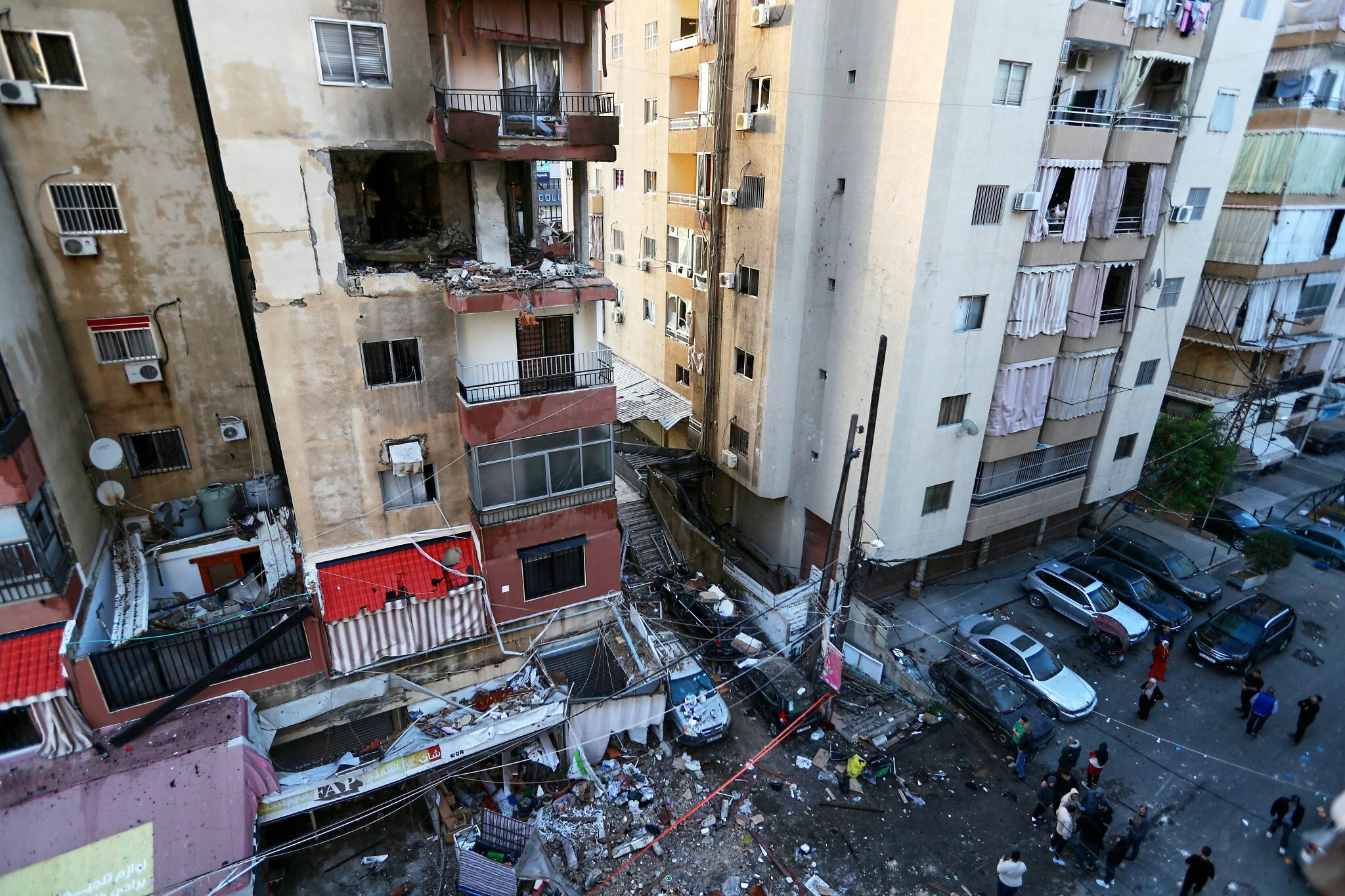

SIDON — Israel killed a Hamas commander on Friday in a pre-dawn airstrike in the Lebanese port city of Sidon, which also claimed the lives of his son and daughter. The attack has sparked condemnation from Lebanese officials, who view it as a violation of the country’s sovereignty and a breach of the ceasefire agreement reached on November 27.
The Israeli military confirmed the operation, stating that the targeted strike aimed at eliminating the commander of Hamas’s western sector in Lebanon. “Overnight, the (army and domestic security agency Shin Bet) conducted a targeted strike in the Sidon area, eliminating the commander of Hamas’s western arena in Lebanon,” the military said in a statement.
The commander, identified as Farhat, was confirmed dead by Hamas’s military wing, the Ezzedine Al Qassam Brigades. The group also confirmed the deaths of Farhat’s son, Hamza, who was also a member of Hamas, and his daughter, Jenan. According to reports from local witnesses, the fourth-floor apartment where the strike occurred was still ablaze, and the attack caused significant damage to the apartment building and neighboring structures, triggering panic in the densely populated area.
The Lebanese state-run National News Agency (NNA) reported that the strike occurred at 3:45 a.m. local time (5:45 a.m. PKT), causing at least three fatalities. The NNA described the attack as a “hostile drone raid” that struck a residential apartment, triggering two explosions and a fire. Emergency responders at the scene recovered “the bodies of three martyrs,” the report added.
Lebanese Prime Minister Nawaf Salam strongly condemned the attack, calling it a “flagrant violation of Lebanese sovereignty.” He also stated that the strike represented a breach of the ceasefire agreement between Israel and Hezbollah, which had been in place since November. Salam called for increased international pressure on Israel to halt such attacks, emphasizing that the strikes were targeting residential areas, placing civilians at significant risk.
This latest attack comes on the heels of a similar Israeli airstrike earlier this week on South Beirut, which killed a Palestinian liaison officer affiliated with Hezbollah. That airstrike marked Israel’s second attack on the Lebanese capital since the ceasefire, and the Lebanese Health Ministry reported four casualties, including a woman. Lebanese officials condemned the strike, but Israel maintained that it was a response to unclaimed rocket fire in the region, which Hezbollah denied responsibility for.
Despite the November ceasefire, hostilities between Israel and Hezbollah have continued to escalate, with Israeli airstrikes targeting the group’s positions in southern Lebanon. Under the ceasefire agreement, Hezbollah was expected to redeploy its forces north of the Litani River, roughly 30 kilometers from the Israeli border, and dismantle any remaining military infrastructure in southern Lebanon. However, Israel has also failed to fully adhere to its commitments under the truce, including the withdrawal of its forces from positions along the UN-demarcated Blue Line, the de facto border between Lebanon and Israel. The truce’s implementation has been fraught with challenges, and both sides continue to accuse each other of violating its terms.
