

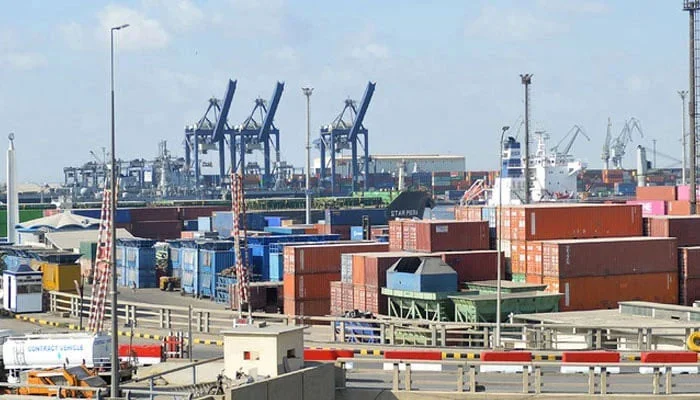

Maritime Mismanagement
ISLAMABAD: Pakistan’s maritime sector suffers an annual loss of nearly Rs5 trillion (Rs5,000 billion or $18 billion) due to a combination of under-utilized ports, tax evasion, fraudulent practices, and inefficiencies in trade and value addition.
A high-level task force report, referenced by an informed government source, highlights these issues and the significant financial impact on the national economy.
According to the report, under-utilized ports alone account for a massive Rs3.19 trillion loss, while tax evasion in the maritime sector contributes to a shortfall of Rs1.12 trillion. Additionally, malpractices and fake billing result in Rs313 billion in losses annually.
Restrictions on trans-shipment, which is the movement of goods between ports or to key trade destinations such as Central Asia and China, cost the economy Rs70 billion. The absence of adequate warehousing and value addition results in a further Rs196 billion in lost revenue. Meanwhile, the misuse of the Afghan Transit Trade system leads to an annual loss of Rs60 billion.
Despite Pakistan’s significant geo-strategic advantages and economic potential, the report laments the country’s failure to fully capitalize on its maritime sector. Notably, none of Pakistan’s ports rank among the world’s top 60. Karachi Port Trust (KPT), currently the busiest port in Pakistan, ranks 61st globally, while Port Qasim Authority (PQA) stands at 146th.
Over the last decade, demand for port services in Pakistan has increased by 3.3% annually. However, KPT, with a total capacity of 125 million tons, operates at only 47% efficiency, despite handling over 60% of the country’s trade. Tax collection from KPT over the past five years has fluctuated between Rs660 billion and Rs1,470 billion.
Similarly, Port Qasim, the country’s second-busiest port, handles about 35% of the total cargo but operates at just 50% of its total 89 million-ton capacity.
Tax collection from PQA in the last five years has ranged between Rs690 billion and Rs1,140 billion. Gwadar Port, after completing its first development phase, currently has a capacity of 2.5 million tons, which is projected to grow to 400 million tons by 2045 upon the completion of its third phase.
The report emphasizes that Pakistan’s coastline, if developed efficiently, could serve as a vital economic asset. It also notes that global maritime giants such as Maersk, DP World, and Hutchison Ports recognize Pakistan’s strategic importance and have shown interest in investing in the sector to leverage the country’s trade routes.
The ongoing crisis in the Red Sea, which has disrupted global shipping, presents an opportunity for Pakistan to enhance its maritime sector and position itself as a key alternative trade hub.
Additionally, the report highlights the decline in Pakistan’s contribution to the global shipping workforce. While the country once provided a steady supply of trained seafarers, its presence in the sector has diminished over time.
The task force also points to the vast potential for tourism along the coasts of Makran and Sindh. With breathtaking beaches, historical sites, archaeological landmarks, and ancient religious locations, these regions could generate significant revenue if properly developed.
Moreover, Pakistan possesses an exclusive economic zone spanning more than 240,000 square kilometers, officially recognized by the United Nations. This zone is rich in seabed resources, including oil, gas, and valuable minerals.
The report urges the government to integrate these resources into the national economy through long-term strategic planning, investment in human capital, infrastructure development, and policy continuity.
In conclusion, Pakistan’s maritime sector holds immense untapped potential. Addressing inefficiencies, strengthening infrastructure, and leveraging global opportunities could transform it into a major economic driver, significantly boosting national revenue and trade.
