

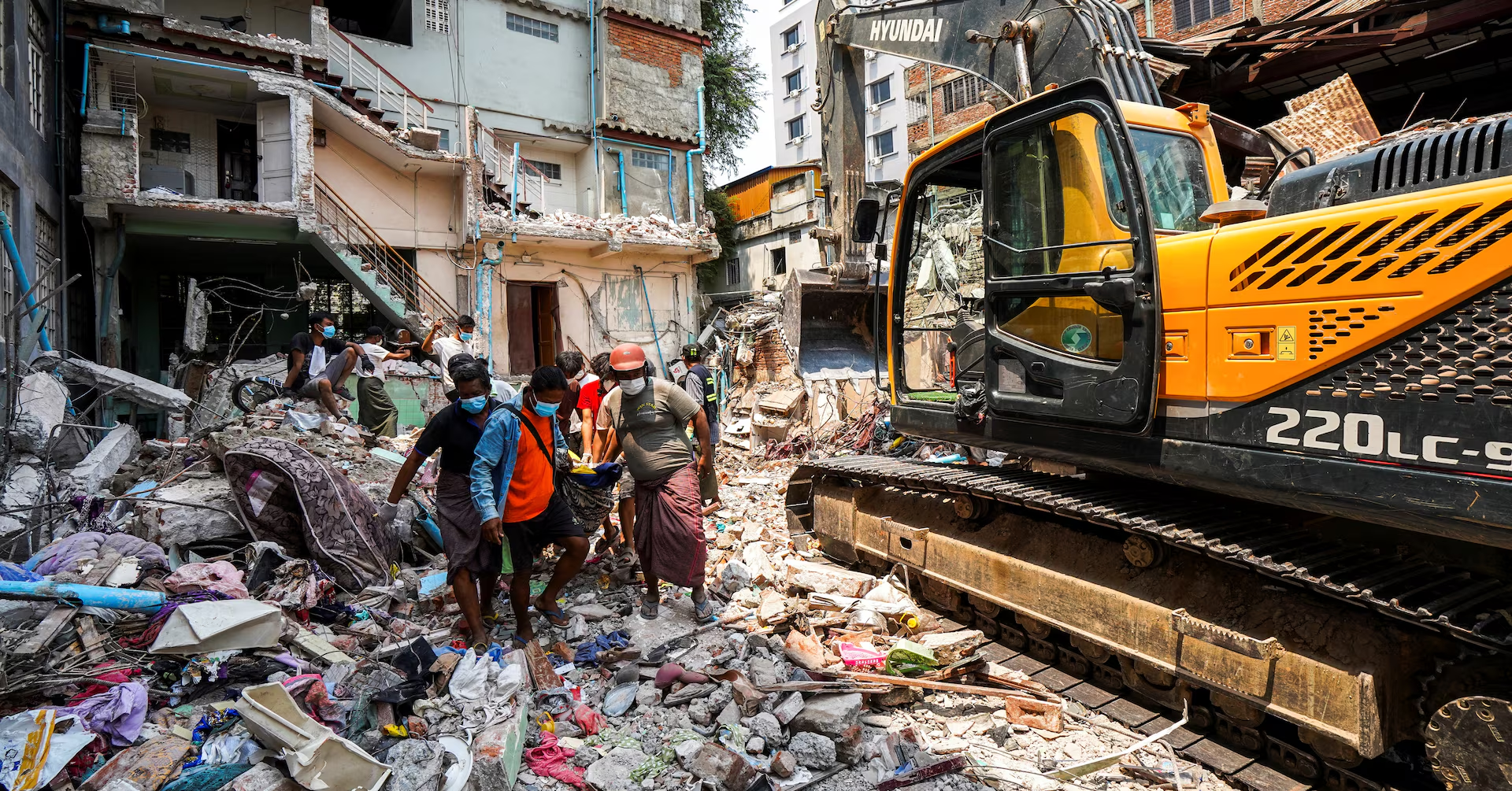

Myanmar Earthquake
BANGKOK: The death toll from Myanmar’s devastating earthquake continues to rise as rescue teams and humanitarian aid rush to assist the affected communities. The powerful 7.7-magnitude earthquake, one of the strongest to hit the country in a century, struck on Friday, leaving at least 1,700 people dead, 3,400 injured, and over 300 missing as of Sunday. Officials warn that the number of casualties may climb further in the coming days.
Myanmar’s military-led government, which has been struggling with ongoing internal conflicts, is now facing immense challenges in dealing with the disaster. Senior General Min Aung Hlaing, the junta chief, acknowledged the severity of the situation and, in a rare move, appealed for international assistance. In response, neighboring countries such as India, China, and Thailand have dispatched relief supplies and personnel, with additional aid coming from Malaysia, Singapore, and Russia.
The scale of destruction has placed significant strain on Myanmar’s already fragile infrastructure. Bridges, highways, airports, and railways have suffered extensive damage, severely hampering relief efforts. Humanitarian organizations, including the International Federation of Red Cross and Red Crescent Societies, have emphasized the urgent need for assistance, particularly as the monsoon season approaches, threatening to exacerbate the crisis.
In a statement, the United States pledged $2 million in aid through humanitarian organizations operating in Myanmar. Additionally, an emergency response team from the U.S. Agency for International Development (USAID) has been deployed to assist with the relief efforts. However, with funding cuts under the Trump administration, the full extent of U.S. support remains uncertain.
The earthquake has further deepened the suffering of Myanmar’s population, already enduring hardship due to a prolonged civil war following the 2021 military coup that ousted the elected government of Aung San Suu Kyi.
The conflict has displaced over 3.5 million people, weakened the country’s economy, and devastated its healthcare system. Many affected areas, particularly near the epicenter in Sagaing, have been left without electricity and clean drinking water. Local residents have reported a lack of government assistance, forcing them to rely on their own limited resources to survive.
Hospitals in central and northwestern Myanmar, including those in Mandalay and the capital Naypyitaw, are overwhelmed with injured patients. The United Nations Office for the Coordination of Humanitarian Affairs has warned that medical facilities are struggling to cope with the surge in casualties. Public and private hospitals, including the Mandalay General Hospital and parts of Mandalay Medical University, sustained damage during the quake, further straining the healthcare system.
Meanwhile, neighboring Thailand also felt the tremors, resulting in the collapse of an under-construction skyscraper in Bangkok. Thai authorities reported at least 18 fatalities, with 76 people still trapped under the rubble. Rescue operations in Bangkok have entered their third day, with emergency teams using drones and sniffer dogs to locate survivors.
Myanmar’s opposition National Unity Government (NUG), which includes former officials from Suu Kyi’s administration, announced that anti-junta militias would pause all offensive military actions for two weeks to focus on humanitarian aid efforts. However, in areas near the quake’s epicenter, such as Sagaing, the destruction is widespread.
Satellite imagery shows that a major bridge connecting Sagaing to Mandalay has collapsed into the Irrawaddy River, cutting off essential transport routes. The political group Sagaing Federal Unit Hluttaw reported that food and medicine are in short supply, and local hospitals lack the capacity to treat the growing number of casualties.
In Mandalay, emergency workers are racing against time to rescue people trapped under collapsed buildings. However, limited access to heavy machinery has slowed down operations, leaving volunteers to dig through rubble using only ropes, gloves, and basic tools. A humanitarian worker described the situation as dire, stating that the actual death toll is likely much higher due to the number of unidentified victims still buried under debris.
Videos from Mandalay show patients being treated outdoors as hospitals struggle to accommodate the injured. Russian and Indian rescue workers are on their way to the city, while teams from China, Thailand, and Singapore have already arrived to assist.
In Bangkok, relatives of trapped construction workers anxiously wait for news of their loved ones. Rescuers, facing dangerous conditions, are working tirelessly to retrieve survivors from the collapsed 33-story building. Thai police commander Teerasak Thongmo emphasized the urgency of the situation, saying that the first 72 hours are critical for saving lives.
As Myanmar grapples with the aftermath of this catastrophic earthquake, the international community is being urged to provide immediate assistance. With thousands of people in desperate need of aid and infrastructure in ruins, the country faces a long and difficult road to recovery.
