

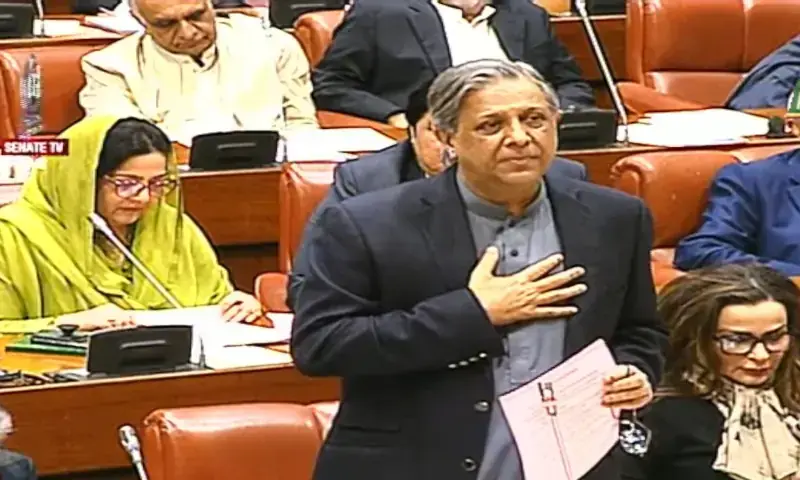

Opposition decries “Baku Amendments” as Law Minister defends reforms on judiciary and military structure
ISLAMABAD — The National Assembly on Tuesday adjourned its session after an intense, day-long debate over the 27th Constitutional Amendment Bill, which aims to introduce sweeping changes to Pakistan’s judicial and military systems. Despite expectations of its approval following the Senate’s green light a day earlier, the lower house did not proceed to a vote amid fierce opposition protests.
A Contentious Debate Over Sweeping Reforms
Law Minister Azam Nazeer Tarar formally tabled the 59-clause amendment, calling it a landmark step toward “institutional balance and efficiency.” The Senate had passed the bill with a two-thirds majority — 64 votes in favor and none against — after opposition lawmakers boycotted the session and tore up copies of the draft in protest.
Addressing the Assembly, Tarar defended the bill, which seeks to establish a Federal Constitutional Court (FCC) and reform judicial appointments and military ranks. He explained that the FCC would handle constitutional and provincial matters, while the Supreme Court would continue to oversee civil and criminal cases, aiming to reduce its current backlog of over 60,000 cases.
“Constitutional courts exist in many democracies. This is not about reducing powers but ensuring better case management and judicial discipline,” Tarar said, while opposition members shouted slogans and banged desks in protest.
On judicial transfers, Tarar detailed that the Judicial Commission of Pakistan would now oversee transfers of judges — replacing presidential discretion. “If a judge refuses a transfer, it will be treated as retirement,” he explained, adding that the commission would include representatives from both the government and opposition to ensure fairness.
He also spoke about codifying the Field Marshal rank within the Constitution, noting it as a “lifelong honor” in recognition of extraordinary military service. “The army chief and our armed forces have protected the nation in times of peril. Bringing the Field Marshal title within constitutional limits formalizes that legacy,” he said.
Tarar further clarified that the presidential immunity clause had been refined — stating that immunity would cease if the president assumes a public office after completing their term.
Opposition Labels Reforms as ‘Baku Amendments’
The opposition benches, led by PTI Chairman Barrister Gohar Ali Khan, lambasted the bill, calling it a “dark day for democracy.” Amid chants and protests, Gohar derided the constitutional tweaks as the “Baku Amendments,” referring to Prime Minister Shehbaz Sharif’s recent visit to Azerbaijan during which the cabinet approved the amendment draft.
“A head of a nuclear state is approving constitutional amendments from abroad — what could be more humiliating?” he said. “These amendments are not for reform; they are for personal protection. Democracy is being buried under the guise of constitutionalism.”
Gohar accused the government of sidelining accountability by shielding powerful figures from legal scrutiny. “When you make laws to protect the elite, you destroy the very spirit of democracy,” he said, citing corruption cases against President Asif Ali Zardari. “If he is innocent, why not face the court and prove it?”
He further claimed the amendment effectively dilutes the powers of the Chief Justice of Pakistan, replacing the office with that of the “Chief Justice of the Supreme Court,” thereby undermining the judiciary’s independence.
“The Constitution is being rewritten to suit a few. We reject these Baku Amendments — this is not reform, it’s regression,” Gohar declared.
Key Highlights of the 27th Constitutional Amendment
-
Establishment of Federal Constitutional Court (FCC) with equal provincial representation.
-
Chief of Army Staff to also serve as Chief of Defence Forces.
-
Field Marshal, Marshal of Air Force, and Admiral of Fleet titles formalized as lifelong honors.
-
FCC empowered to take suo motu notice upon petitions.
-
One judge from Islamabad High Court to serve on FCC bench.
-
Supreme Court’s jurisdiction narrowed to civil and criminal matters.
-
Judicial Commission to handle judge transfers; refusals treated as retirement.
-
Presidential immunity limited to tenure only; voided if holding post-office roles.
-
Judges must complete five years of service in a high court to qualify for the FCC.
The National Assembly session opened with prayers for PML-N Senator Irfan Siddiqui, who passed away Monday night, before delving into what became one of the most heated debates of the parliamentary year.
The session will reconvene later this week, where the government is expected to push again for a vote on the bill — though opposition lawmakers have vowed to resist what they call an “assault on the Constitution.”
