

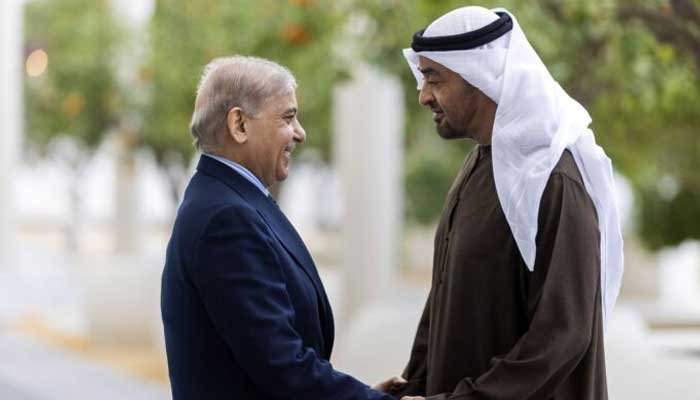

Prime Minister Shehbaz Sharif addressed the World Governments Summit 2025 in Dubai on Tuesday, emphasizing that Pakistan is at a “defining moment” in its economic transformation. Reflecting on the government’s efforts to stabilize the country’s economy, the prime minister stated, “Despite significant challenges, securing our economy has been a central achievement over the past year.”
He highlighted key economic achievements, including a drop in headline inflation to 2.4% in January—the lowest in nine years—and a capped interest rate of 12%, which he described as a significant stimulus for private sector credit. “Economic stability is a means, not an end… Our National Economic Transformation Plan, Uraan Pakistan, is driving change by focusing on exports, e-Pakistan, environment and climate change, energy, infrastructure, and equity,” he added.
PM Shehbaz underscored the importance of energy security and sustainability, stating that these issues are both economic necessities and national priorities. He reiterated Pakistan’s commitment to achieving a 60% clean energy mix by 2030 and transitioning 30% of all vehicles to electric mobility. “We are rapidly scaling up solar, wind, hydropower, and nuclear energy. Our southern regions alone hold 50,000 MW of untapped wind energy potential,” he said, further noting that northern hydropower projects will add 13,000 MW of clean energy capacity.
The prime minister also discussed Pakistan’s efforts to accelerate solar energy adoption through policy reforms, tax exemptions, investment incentives, and waiving customs duties on solar panels and equipment.
“Pakistan offers one of the most dynamic investment landscapes in Asia, with 70% of our young, tech-savvy population under 30. Our strategic location bridges South and Central Asia, and with an emerging middle class, our economy presents promising opportunities,” he said, stressing the government’s efforts to simplify business regulations, enhance legal protections, and streamline investment approvals to make Pakistan a leading destination for global capital.
To further boost investment, PM Shehbaz mentioned the establishment of the Special Investment Facilitation Council (SIFC) to focus on sectors such as renewable energy, resilient infrastructure, digital economy, minerals, and agriculture. He highlighted Pakistan’s commitment to eco-friendly agricultural innovations under the adaptation policy of 2023 to improve productivity, ensure food security, and strengthen the rural economy.
The government is also working to improve water efficiency through initiatives such as drip irrigation, precision farming, drought-resistant crops, and solar-powered irrigation systems, aiming to modernize agriculture and reduce environmental impacts.
While the government pursues growth targets, PM Shehbaz emphasized the importance of creating equitable opportunities, uplifting communities, and building a prosperous future for the people. He called for increased international partnerships and financial support to meet climate goals, noting that Pakistan’s energy transition alone requires an investment of $100 billion.
“The global shift to a green economy requires a shared responsibility. While we are fully committed to mobilizing domestic resources, international support remains crucial,” the prime minister said.
Concluding his speech, PM Shehbaz expressed optimism about Pakistan’s future, stating, “We stand at the threshold of a new era, one focused on infrastructure, economic diversification, and human development. The future is something we actively shape—let this summit herald the dawn of a globally prosperous and sustainable future for all.”
PM Shehbaz Meets UAE President
On the sidelines of the summit, PM Shehbaz met with UAE President and ruler of Abu Dhabi, Sheikh Mohamed bin Zayed Al Nahyan. The leaders discussed enhancing bilateral trade and economic cooperation, as well as recent developments in the Middle East. Chief of the Army Staff General Syed Asim Munir also attended the meeting.
The discussions focused on areas of mutual interest, such as economic growth, trade, and sustainable development. Both sides explored opportunities to deepen cooperation, emphasizing the importance of leveraging global governance trends to accelerate development and build a better future.
